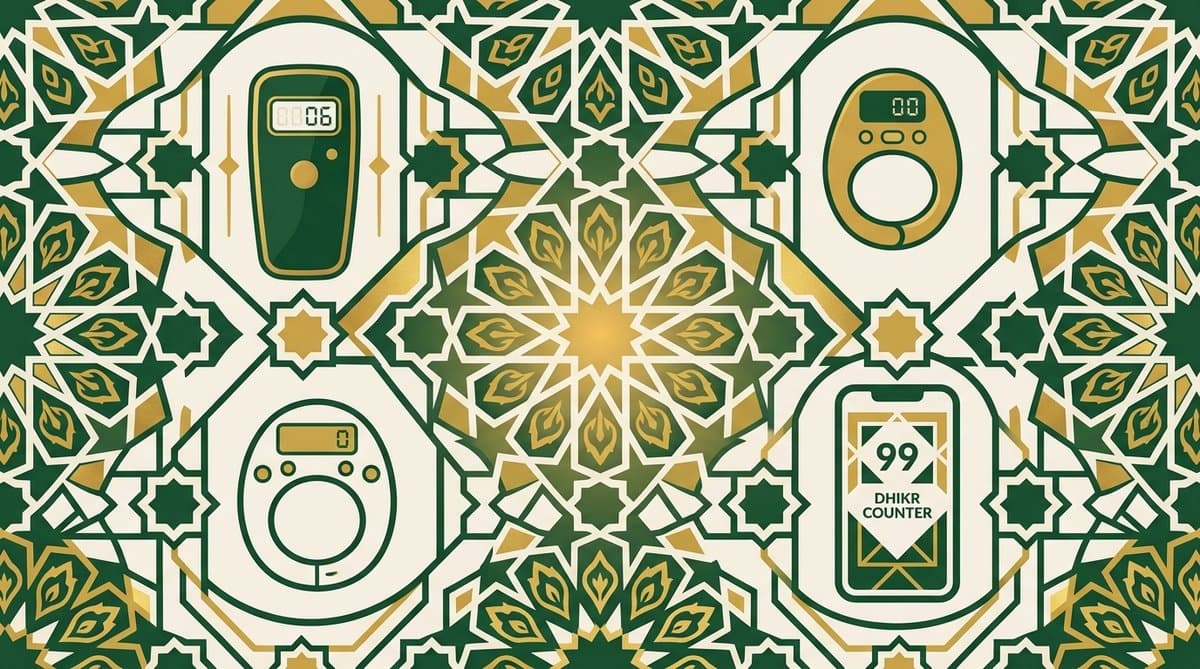
The remembrance of Allah (dhikr) is the nourishment of the soul and the polish of the heart. In the beautiful words of the Quran, Allah says, « Unquestionably, by the remembrance of Allah hearts are assured » (Surah Ar-Ra’d, verse 28). As we transition from the spiritually intensive days of Ramadan, the challenge for many of us is to maintain that elevated connection. A simple yet powerful tool that can help us build this lasting habit is a dhikr counter, or what is sometimes called a ‘compteur dhikr’. This guide will explore how this humble instrument can become a profound companion in our spiritual journey.
The Spiritual Foundation: What is Dhikr and Why is it Essential?
Dhikr, in its essence, is the conscious and deliberate remembrance of Allah ﷺ. It is far more than the mere mechanical repetition of phrases; it is a state of heart-awareness, a continuous effort to keep Allah at the forefront of one’s mind and life. The Quran and the Sunnah of Prophet Muhammad ﷺ are replete with injunctions and encouragements regarding this noble act of worship. Allah commands us, « O you who have believed, remember Allah with much remembrance » (Surah Al-Ahzab, verse 41). This isn’t a casual suggestion but a divine instruction, highlighting its paramount importance.
The Prophet Muhammad ﷺ beautifully illustrated the vitality of dhikr when he said, « The likeness of the one who remembers his Lord and the one who does not remember Him is the likeness of the living and the dead. » (Narrated by Al-Bukhari). This powerful analogy frames dhikr not as an optional accessory to faith, but as its very lifeblood. It is what keeps the spiritual heart alive, vibrant, and connected to its Creator. The benefits are both immediate and eternal: it brings tranquility to the anxious mind, polishes away the rust of sins from the heart, and builds a treasure for us in the Hereafter.
Dhikr is a uniquely accessible form of worship. It does not require a specific time, place, or state of ritual purity for many of its forms. It can be practiced while walking, driving, working, or waiting in a queue. This constant connection transforms mundane moments into opportunities for reward and spiritual elevation. It is the practice that bridges the gap between our formal prayers (Salah) and the rest of our day, ensuring that our awareness of Allah is not confined to the prayer mat but extends into every facet of our existence.
From Traditional Misbaha to Digital Apps: A Guide to Dhikr Counters
To aid in the practice of dhikr, particularly when reciting specific phrases a set number of times as encouraged by the Sunnah, Muslims have historically used various counting methods. The Prophet ﷺ and his companions would use their fingers, a practice that is still considered a beautiful Sunnah. Over time, tools were developed to help maintain focus and accuracy. Today, we have a wide array of options, each with its own unique feel and functionality.
The Traditional Misbaha (Tasbeeh Beads)
The misbaha, or tasbeeh, is perhaps the most iconic dhikr counter. Typically consisting of 33 or 99 beads, it provides a tangible, tactile experience that many find grounding. The rhythmic movement of the beads through one’s fingers can aid concentration, creating a physical anchor for the spiritual act. It requires no batteries and its simplicity is its strength. For many, the feel of the wooden, stone, or glass beads is an inseparable part of their dhikr ritual, a familiar comfort that helps quiet the mind and focus the heart.
The Digital Tasbeeh Ring
A modern innovation, the digital tasbeeh ring is a small, electronic counter worn on the index finger. With a simple press of a button for each recitation, it keeps a digital tally. Its primary advantage is its discretion and portability. You can easily use it while driving, walking, or in a public space without drawing attention. It’s lightweight and frees your other hand, making it incredibly practical for a busy lifestyle. It allows a Muslim to seamlessly integrate dhikr into their active day.
The Online Dhikr Counter & Mobile Apps
In our digital age, our smartphones can also serve as powerful tools for worship. Mobile apps and web-based counters offer features that go beyond simple counting. They often come with pre-loaded adhkar (plural of dhikr), such as the supplications recited after prayer or in the morning and evening, saving you the need to memorize them immediately. They can track your progress over days and weeks, providing motivation through streaks and statistics. For a seamless experience on your phone or computer, you can use a dedicated digital Tasbeeh counter that not only counts but also saves your progress and offers pre-set supplications, making it easier than ever to maintain consistency.
Finding Your Perfect Companion for Remembrance
Choosing the right dhikr counter is a personal decision that depends heavily on your lifestyle, goals, and what resonates with you spiritually. There is no single « best » option; the best tool is the one that you will consistently use to connect with Allah. To make an informed choice, consider a few key factors that align with your daily life and spiritual aspirations.
First, assess your daily routine. Are you often on the move, commuting or running errands? A discreet digital ring or a mobile app might be most suitable. Do you have dedicated time for worship at home or in the mosque where you can sit peacefully? The traditional misbaha might provide a more meditative experience. Do you find motivation in tracking your progress and seeing your achievements build over time? A feature-rich app would be the ideal choice. The tool should fit into your life, not require you to change your life to fit the tool.
Second, think about your spiritual objectives. Are you focused on establishing the Sunnah of reciting SubhanAllah, Alhamdulillah, and Allahu Akbar 33 times after each prayer? Any simple counter will suffice. Are you aiming for larger numbers, like 1000 repetitions of Istighfar (seeking forgiveness) daily? A digital counter that won’t lose its place is invaluable. The prophetic tradition is rich with specific supplications for various occasions, and having them readily available can be a great blessing. You can explore a collection of these authentic supplications (duas) to see which ones you’d like to incorporate into your daily routine, which can then guide your choice of counter.
Comparison of Dhikr Counter Types
To help you decide, here is a simple comparison of the most common types of dhikr counters based on different criteria:
| Counter Type | Portability | Discretion | Features | Spiritual Feel |
|---|---|---|---|---|
| Traditional Misbaha | Moderate (can be bulky) | Low | Basic (counting) | High (tactile, traditional) |
| Digital Ring Counter | High | High | Moderate (counting, reset) | Moderate (practical, modern) |
| Mobile App Counter | High (on your phone) | Moderate (screen is visible) | High (tracking, presets, history) | Varies (can be distracting) |
| Using Fingers (Sunnah) | Highest (always with you) | Highest | Basic (counting up to 33) | Highest (direct Sunnah) |
Ultimately, the goal is to remove any friction that stops you from remembering Allah. Experiment with different types and see which one becomes a natural extension of your desire to perform dhikr.
Integrating Dhikr Into Your Daily Routine: Practical Steps
Acquiring a tool is the easy part; building a lasting habit is where the real effort lies. The blessed month of Ramadan provides us with an annual spiritual reset, but the key is to carry that momentum forward. The secret to consistency is not grand, sporadic gestures of worship, but small, sustainable daily actions.
One of the most effective strategies is « habit stacking. » This involves linking the new habit of dhikr to an existing one. For example, make a commitment: « After I finish my Fajr prayer, I will recite my post-salah adhkar, » or « During my morning commute, I will spend 10 minutes reciting Salawat upon the Prophet ﷺ. » The most natural and blessed times for dhikr are those prescribed by the Sunnah, especially after the five daily prayers. This is a built-in opportunity. By making it a non-negotiable part of your post-prayer routine, you create five anchor points for remembrance throughout your day. Just as a tool can help track your dhikr, building a solid foundation of daily prayer is crucial. You can use a prayer tracker to maintain consistency with your five daily Salah, creating these natural moments for dhikr.
Another powerful technique is to designate specific adhkar for specific activities. You could dedicate your time spent cooking or cleaning to reciting « La hawla wa la quwwata illa billah » (There is no power and no strength except with Allah). While walking, you could be reciting « SubhanAllahi wa bihamdihi, SubhanAllahil ‘adheem. » This transforms idle time into a continuous stream of worship. Use technology to your advantage by setting reminders on your phone at key moments, like mid-morning or late afternoon, to pause for a few minutes of remembrance. The goal is to weave dhikr so seamlessly into the fabric of your day that it becomes as natural as breathing.
Beyond Counting: The True Essence of Dhikr
While a dhikr counter is an excellent aid for consistency and accuracy, it is crucial to remember that it is merely a tool. The true objective of dhikr is not to hit a certain number, but to achieve a state of *ihsan*—worshipping Allah as though you see Him. The quality of our remembrance is ultimately more important than the quantity.
As you use your counter, make a conscious effort to engage your heart and mind. Before you begin, take a moment to renew your intention. As you recite « SubhanAllah » (Glory be to Allah), reflect on His perfection and transcendence above all flaws. When you say « Alhamdulillah » (All praise is for Allah), bring to mind the countless blessings He has bestowed upon you. When you proclaim « Allahu Akbar » (Allah is the Greatest), feel His magnificence and might in your heart, dwarfing all worldly concerns. Reflecting on His perfect attributes can add incredible depth to your remembrance, and you can deepen this connection by exploring the 99 Names of Allah and their profound meanings.
The journey of dhikr is a progression from the tongue to the mind, and finally, to the heart. Initially, the counter helps discipline the tongue. With persistence, the meanings start to occupy the mind. In time, with sincerity and the help of Allah, this remembrance permeates the heart, influencing our character, our decisions, and our entire outlook on life. A hundred recitations with presence of heart are far more beloved to Allah than ten thousand recited with a heedless, wandering mind. Let the counter be your assistant, but let your heart be the true locus of your worship.
Frequently Asked Questions
Is it permissible in Islam to use a dhikr counter (tasbeeh)?
Yes, it is permissible for a Muslim to use a dhikr counter, whether it’s traditional beads (misbaha) or a digital device. While the Sunnah is to use the fingers of the right hand, scholars consider counters to be a helpful tool (bid’ah hasanah or good innovation) for accuracy and consistency, especially for large numbers of recitations. The tool itself is neutral; what matters is the intention and sincerity behind the dhikr.
Does a digital dhikr counter have the same reward as using fingers?
The highest reward is in following the Sunnah of the Prophet Muhammad ﷺ, which was to use the fingers for tasbeeh, as they will testify for a person on the Day of Judgment. However, using a counter is permissible and one is still rewarded for the act of dhikr itself. The tool is a means to an end, and using it does not negate the reward of remembrance.
What is the best dhikr to do daily?
Some of the most recommended daily adhkar from the Sunnah include saying SubhanAllah (33 times), Alhamdulillah (33 times), and Allahu Akbar (34 times) after each obligatory prayer. Other powerful phrases are Istighfar (seeking forgiveness), Salawat upon the Prophet ﷺ, and the phrase ‘La ilaha illallah wahdahu la sharika lah, lahul-mulku wa lahul-hamdu wa huwa ‘ala kulli shay’in qadeer’.
How can I stay consistent with dhikr after Ramadan?
To maintain consistency, start small and be realistic. Attach your dhikr practice to an existing habit, like your five daily prayers. Use a dhikr counter or app to track your progress for motivation, and set reminders on your phone. Most importantly, constantly renew your intention and ask Allah for steadfastness.
Can I do dhikr without wudu (ablution)?
Yes, you can perform most forms of dhikr, such as tasbeeh, tahmeed, and takbeer, without having wudu. This is one of the great blessings and accessibilities of dhikr. The only act of worship that strictly requires wudu is the ritual prayer (Salah) and touching a physical copy of the Mushaf (Quran).
What are the ‘everlasting good deeds’ mentioned in the Quran?
The ‘everlasting good deeds’ (al-baqiyat al-salihat) mentioned in Surah Al-Kahf are interpreted by many scholars to be the phrases: ‘SubhanAllah’ (Glory be to Allah), ‘Alhamdulillah’ (All praise is for Allah), ‘La ilaha illallah’ (There is no god but Allah), and ‘Allahu Akbar’ (Allah is the Greatest). Reciting these is considered one of the most beloved forms of dhikr.
What is the difference between tasbeeh, tahmeed, and takbeer?
These are three of the most common forms of dhikr. Tasbeeh is the act of glorifying Allah by saying ‘SubhanAllah’. Tahmeed is the act of praising Allah by saying ‘Alhamdulillah’. Takbeer is the act of magnifying Allah by saying ‘Allahu Akbar’. These are often recited together, especially after prayers.
The remembrance of Allah is a path to inner peace and a means of drawing closer to our Creator. In our quest for consistency, a dhikr counter can be a humble but invaluable ally, helping us transform fleeting intentions into steadfast habits. Whether you choose the traditional feel of a misbaha or the modern convenience of a digital app, let it be a tool that disciplines your tongue so that your heart may learn the language of perpetual remembrance. May Allah make our tongues moist with His dhikr and our hearts find tranquility in it.