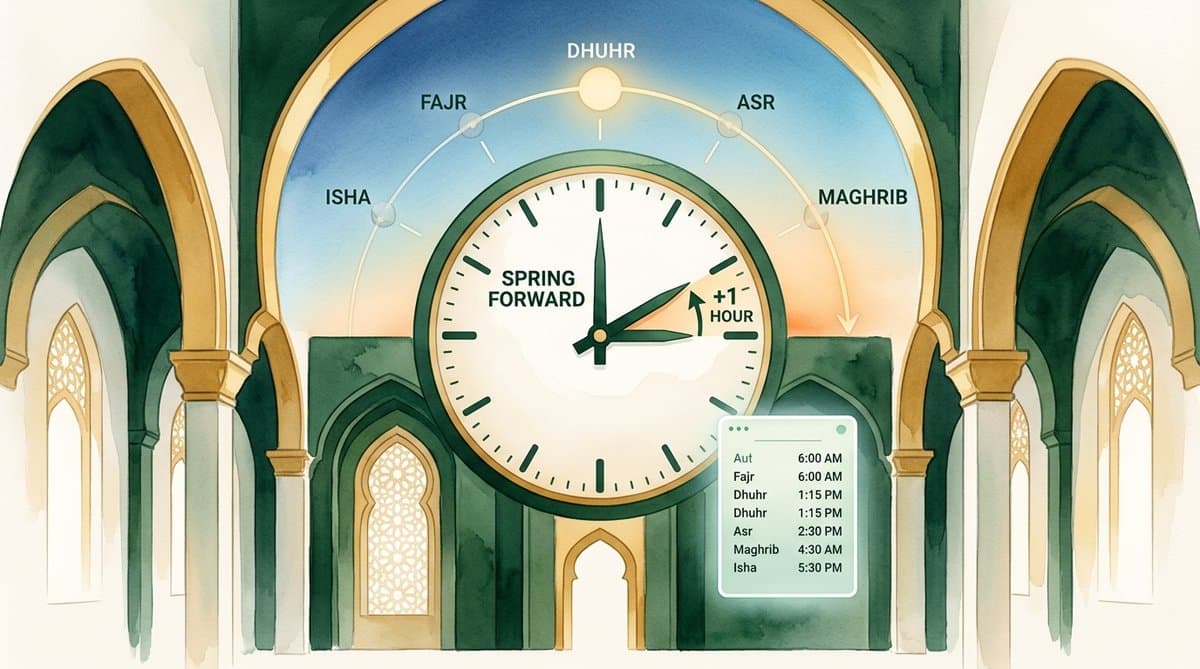
As the seasons change, so do our clocks. This coming weekend, many countries will spring forward for Daylight Saving Time (DST), a shift that can bring confusion to our daily routines. For Muslims, this adjustment is more than just losing an hour of sleep; it directly impacts the sacred rhythm of our five daily prayers. Understanding the relationship between daylight saving prayer times and the astronomical clock set by Allah is key to maintaining consistency in our worship, ensuring we answer the call to prayer at its proper time without disruption.
What is Daylight Saving and How Does It Affect Salah?
Daylight Saving Time is the practice of advancing clocks, typically by one hour, during the warmer months. The goal is to make better use of natural daylight in the evenings. However, Islamic prayer times are not determined by our clocks but by the position of the sun in the sky. Allah says in the Quran, « Indeed, prayer has been decreed upon the believers a decree of specified times » (Surah An-Nisa, verse 103). These specified times are linked to observable, natural phenomena: the first light of dawn (Fajr), the sun passing its zenith (Dhuhr), the lengthening of shadows (Asr), sunset (Maghrib), and the disappearance of twilight (Isha).
When we manually change our clocks, we are altering the man-made system we use to measure time. The sun, however, continues its path unchanged. Therefore, when the clock on your wall or phone jumps from 2:00 AM to 3:00 AM, the astronomical events that define prayer times also shift forward by one hour on that clock. If Fajr was at 5:15 AM before the change, it will now be at 6:15 AM. The actual moment of dawn remains the same, but its label on our time-keeping devices has changed. This is a crucial distinction: DST does not change the *reality* of prayer times, only their *representation* on our schedules.
This shift requires a conscious adjustment from every Muslim. Our internal spiritual clock must be recalibrated to align with the new clock times. The length of the day for fasting purposes remains the same, as does the interval between each prayer. The challenge lies in adapting our daily habits—our sleep, work, and family schedules—to this new timetable for worship. The key is preparation and leveraging reliable resources to stay informed. To ensure you always have the correct times, you can consult the accurate, location-based prayer times schedule on Al Muslim Plus, which automatically adjusts for DST.
The Critical Fajr Prayer: Avoiding the Common Pitfall
The most significant challenge for many Muslims during the DST transition is the Fajr prayer. As we lose an hour of sleep, the new, later time for Fajr can be easily missed. An alarm set for 5:00 AM the night before will ring at what is now effectively 4:00 AM, but the prayer time itself has shifted to after 6:00 AM. Conversely, if your phone updates automatically but your standalone alarm clock does not, you might wake up an hour too late, after sunrise (Shuruq).
The Prophet Muhammad ﷺ emphasized the immense value of this prayer, saying, « The two rak’ahs of Fajr are better than this world and all that it contains » (Narrated by Muslim). Missing it is a great spiritual loss. The first few days after the time change are particularly delicate as our bodies and minds adjust. The key to safeguarding your Fajr prayer is proactive preparation. The evening before the change, take a moment to verify the new prayer times for the following day. Double-check all your alarms, both digital and manual, to ensure they are set correctly for the new schedule.
To build a consistent habit during this transition, consider using a dedicated tool to monitor your prayers. The Al Muslim Plus app features a Prayer Tracker that can help you stay accountable and build streaks, providing positive reinforcement as you adapt. Setting a special, distinct alarm for Fajr and placing it across the room can also help ensure you wake up fully. Finally, make a sincere dua to Allah the night before, asking Him to help you wake up for this blessed prayer. The intention and effort are the first and most important steps.
Adjusting Your Daily Routine for Dhuhr, Asr, Maghrib, and Isha
While Fajr presents the most immediate challenge, the daylight saving shift impacts the entire day’s prayer schedule, requiring adjustments to work, school, and family life. The Dhuhr and Asr prayers, which often fall during the workday or school hours, will now occur an hour later. What was once a prayer during a scheduled lunch break might now fall in the middle of a meeting or class. It is wise to review your work calendar and plan accordingly, perhaps blocking out 15-minute slots for prayer to ensure you can fulfill your obligation without stress.
Maghrib, the prayer that marks the end of the fasting day, also shifts an hour later into the evening. For families, this means Iftar (the meal to break the fast) and dinner time will be delayed. It’s important to communicate this change within the household so everyone, especially children, can adjust their expectations and routines. This later Maghrib can also feel like a blessing, providing an extra hour of daylight for outdoor activities or running errands after work before it’s time to pray and eat. This is a good time to check in with your local community. Using a Mosque Finder can help you find the updated congregational prayer (jama’ah) times at nearby Islamic centers, as their schedules for Maghrib and Isha will also have changed.
Similarly, the Isha prayer will be performed an hour later, which can push back your evening routine and bedtime. This can be challenging, especially for those who need to wake up early for work or school. It may require a conscious effort to wind down earlier in the evening to ensure you get adequate rest while still performing Isha at its proper time. One beautiful way to embrace this shift is to use the new schedule to incorporate more dhikr (remembrance of Allah). After praying Isha, you can use a digital Tasbeeh counter to engage in remembrance, helping to calm the mind and prepare for a restful sleep before waking up for the new Fajr time.
Practical Checklist for a Smooth DST Transition
Navigating the change in daylight saving prayer times can be seamless with a little forethought and the right tools. Instead of feeling disoriented, you can approach the transition with confidence and mindfulness. Here is a practical checklist to help you and your family adapt smoothly, ensuring your connection to Allah through salah remains strong and consistent.
First, embrace technology to your advantage. A reliable Islamic app is your best companion during this period. The Al Muslim Plus app automatically updates prayer times based on your location and local DST rules, removing any guesswork. This is the single most effective step you can take. Second, communicate proactively. Discuss the new prayer and meal schedules with your family the day before the change. This prevents confusion and helps everyone, especially children, adapt to the new rhythm of the household. Third, prepare your environment. The night before the time change, perform a full alarm audit. Check your phone, bedside alarm clock, and any other devices you rely on. Set them for the new Fajr time to avoid any morning surprises.
Finally, adjust your daily mindset. See this change not as an inconvenience but as a reminder of the dynamic nature of time and our constant need to be mindful of our duties to Allah. The first few days might feel unusual, but with patience, your body and habits will adapt. Use this as an opportunity to renew your intention for each prayer, focusing on its spiritual significance rather than just the time on the clock. By being prepared, you turn a potential disruption into a moment of heightened spiritual awareness.
Frequently Asked Questions
Do my prayer times really change during daylight saving?
Yes, the clock times for your prayers will change. While the astronomical events that define salah times (like sunrise and sunset) remain the same, their labels on our clocks shift forward by one hour. For example, a 5:30 AM Fajr becomes a 6:30 AM Fajr.
Why does Fajr prayer time seem to change the most?
Fajr is the most noticeable change because it directly impacts our sleep schedule. The one-hour shift can easily lead to oversleeping if alarms are not adjusted correctly, making it the prayer most at risk of being missed during the DST transition.
If I forget to change my clock and miss a prayer, what should I do?
If you unintentionally miss a prayer due to the time change, you should perform it as soon as you remember. The Prophet Muhammad ﷺ said, « Whoever forgets a prayer, let him pray it when he remembers it, for there is no expiation for it other than that. » (Narrated by Al-Bukhari and Muslim).
Does the Qibla direction change with Daylight Saving Time?
No, the Qibla direction does not change. The Qibla is the fixed direction of the Kaaba in Mecca. It is a physical location on Earth and is not affected by changes in timekeeping systems like Daylight Saving Time.
How do I explain the prayer time change to my children?
Explain it simply: « We are moving the numbers on the clock, so our prayer times have new numbers too. » Use it as a teaching moment about how prayer times follow the sun, a creation of Allah, not just the clock on the wall.
Do Islamic prayer apps automatically adjust for DST?
Most modern, high-quality Islamic prayer apps, such as Al Muslim Plus, are designed to automatically account for Daylight Saving Time changes based on your device’s location and settings. This makes them a very reliable tool for getting accurate prayer times.
Is Daylight Saving Time mentioned in the Quran or Sunnah?
No, Daylight Saving Time is a modern, man-made convention and is not mentioned in the Quran or Sunnah. Islamic teachings on time are based on the natural cycles of the sun and moon, which are constant and ordained by Allah.
The shift to Daylight Saving Time is a recurring event that requires a small but important adjustment in the life of a Muslim. By understanding why the times change and by preparing in advance, we can ensure our sacred schedule of prayer continues uninterrupted. The key is to be proactive: verify the new times, adjust your alarms, and communicate with your family. This small effort helps maintain the most important pillar of our faith after the shahada. Let this change be a reminder to renew our commitment to performing each salah on time, with mindfulness and devotion.