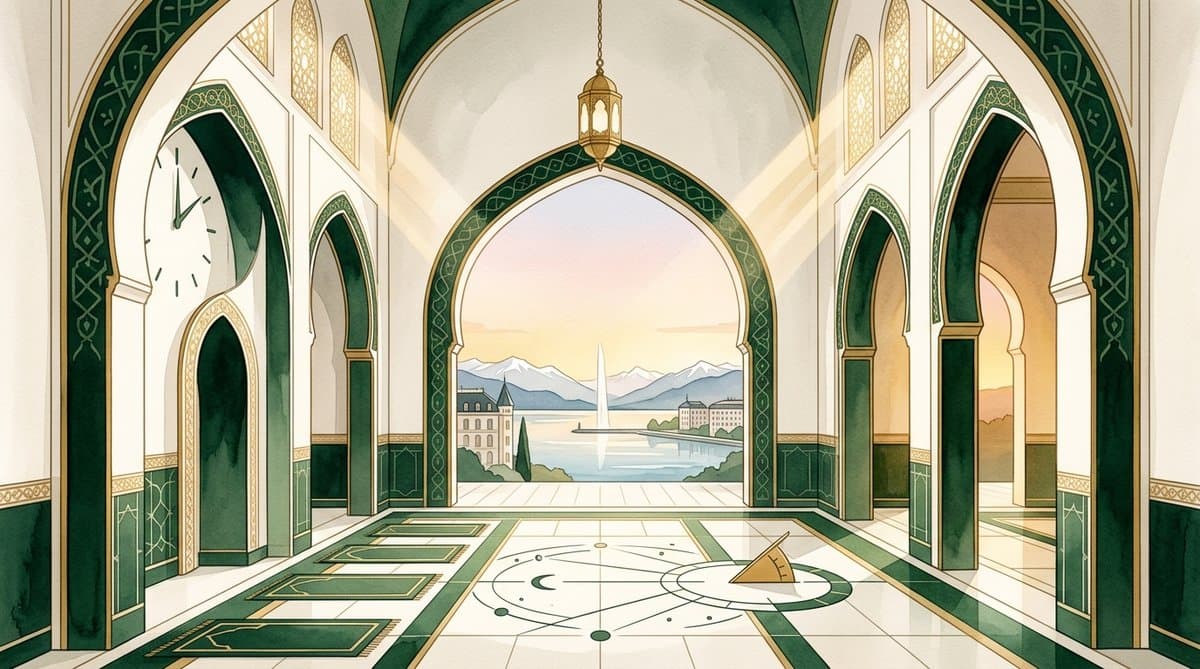
Nestled by its iconic lake and surrounded by the Alps, Geneva is a city of global importance and serene beauty. For the vibrant Muslim community calling this Swiss city home, a central pillar of daily life is the salah, the five daily prayers. Observing these prayers on time connects a believer to Allah and the global Ummah. However, keeping track of the precise ‘horaire prière Genève’ can be challenging due to the city’s northern latitude, which causes significant seasonal shifts in daylight hours. This guide is designed to help you navigate the prayer schedule in Geneva, connect with the local community, and maintain a consistent and fulfilling prayer routine.
Understanding How Prayer Times Are Determined in Geneva
The five daily prayers in Islam are not set by a clock but by the position of the sun. This celestial rhythm is a beautiful reminder of Allah’s creation and cosmic order. Each prayer has a specific window during which it must be performed. Understanding this basis is key to appreciating the daily shifts in the prayer schedule. From the first light of dawn for Fajr to the complete darkness of the night for Isha, these timings are a direct connection to the natural world.
In a city like Geneva, these timings can change by several minutes each day. The most dramatic shifts occur during the transitions between seasons. In the summer, the days are long, leading to a very late Isha prayer and an extremely early Fajr. Conversely, winter brings short days, with the prayer times clustered much closer together. This requires Muslims to be mindful and adaptable, constantly aware of the sun’s journey across the sky. For travelers or new residents, this can be particularly disorienting at first, but it quickly becomes a familiar and cherished part of life in the city.
To standardize prayer times across the globe, Islamic authorities have established specific calculation methods. For Geneva and much of Europe, the most commonly used method is that of the Muslim World League (MWL). This method specifies the solar depression angles for Fajr (18 degrees) and Isha (17 degrees). These angles determine when the first light of dawn appears and when the last light of twilight disappears. It’s this precise astronomical science that ensures prayer times are both accurate and consistent for the entire community. Furthermore, Switzerland observes daylight saving time, meaning the clocks are adjusted forward by an hour in the spring and back by an hour in the autumn, causing a sudden shift in the prayer schedule that believers must account for.
The Five Daily Prayers and Their Time Windows
Each of the five prayers (salah) has a designated period. Performing the prayer within this window is a fundamental requirement. While praying at the beginning of the time is encouraged, the prayer is valid as long as it is completed before the next prayer’s time begins (with the exception of Fajr, which ends at sunrise).
A Table of Prayer Windows
| Prayer Name | Beginning of Time Window | End of Time Window |
|---|---|---|
| Fajr (Dawn Prayer) | Begins at true dawn, when the first light appears on the horizon. | Ends at sunrise. |
| Dhuhr (Midday Prayer) | Begins just after the sun passes its highest point (zenith). | Ends when the time for Asr begins. |
| Asr (Afternoon Prayer) | Begins when the length of an object’s shadow equals the length of the object itself, plus its shadow length at noon. | Ends at sunset. |
| Maghrib (Sunset Prayer) | Begins just after the sun has completely set below the horizon. | Ends when the time for Isha begins. |
| Isha (Night Prayer) | Begins when the twilight has disappeared from the sky. | Ends at the beginning of Fajr’s time. |
The Muslim Community and Major Mosques in Geneva
Geneva is home to a diverse and well-established Muslim community, with roots from the Balkans, Turkey, North Africa, the Middle East, and beyond. This multicultural fabric enriches the Islamic experience in the city, offering a welcoming environment for both residents and visitors. The community is active, with numerous organizations and centers dedicated to worship, education, and social services. These institutions play a crucial role in preserving Islamic identity and fostering a sense of belonging for Muslims in a European context.
The most prominent Islamic institution in the city is the Geneva Grand Mosque (Mosquée de Genève), officially the mosque of the Islamic Cultural Foundation of Geneva. Inaugurated in 1978 and financed by King Khalid ibn Abd al-Aziz of Saudi Arabia, it stands as a significant landmark. Located near the United Nations headquarters, it serves as a central hub for the community, hosting the five daily prayers, Jumu’ah (Friday) prayers, Eid celebrations, and various educational programs. Its impressive architecture and large capacity make it a focal point for thousands of worshippers.
Beyond the Grand Mosque, there are several other mosques and cultural centers scattered throughout the canton of Geneva, catering to different linguistic and cultural groups within the Muslim community. These centers are vital for community life, offering everything from Quranic classes for children to lectures for adults and social support for those in need. If you are new to the city or exploring a different neighborhood, using a digital mosque finder can be an invaluable tool to help you locate the nearest place for congregational prayer and connect with fellow Muslims.
Practical Tips for Maintaining Your Salah Schedule in Geneva
Consistency in prayer, especially in a fast-paced city with fluctuating daylight, requires intention and good habits. The key is to integrate salah seamlessly into your daily life, making it a source of peace rather than a stressful obligation. The first step is to have a reliable source for prayer times. While mosque calendars are useful, a dedicated mobile application provides the most convenience and accuracy, adjusting automatically for daily changes and daylight saving.
To ensure you never miss a prayer, especially when the times are changing, it is essential to have a trustworthy tool at your fingertips. You can always find the precise horaire prière Genève on the Al Muslim Plus platform, which provides accurate, location-based timings and customizable adhan notifications for each salah. This removes the guesswork and allows you to focus on your worship. Setting these notifications can transform your phone from a source of distraction into a reminder of your connection with Allah.
Building a routine is also paramount. Try to link your prayers to other daily activities. For example, make Wudu (ablution) before leaving work so you are ready for Maghrib as soon as it comes in. Use your lunch break for Dhuhr. In the long summer evenings, perform Isha as a final act before settling down for the night. Visualizing your commitment can be a powerful motivator; using a digital prayer tracker can help you build a consistent habit and celebrate your streaks of dedication. Finally, whether you’re in a new office, a hotel room, or a park by the lake, knowing the direction of prayer is crucial. A reliable Qibla compass on your phone provides instant and accurate direction to the Kaaba, ensuring your prayers are properly oriented wherever you are.
Beyond the Timings: Deepening Your Connection in Prayer
While punctuality in prayer is vital, the ultimate goal of salah is to establish a deep and meaningful connection with Allah. It is a moment of tranquility, reflection, and gratitude that punctuates our busy days. The Prophet Muhammad ﷺ described prayer as the ‘coolness of my eyes,’ a source of profound comfort and joy. To cultivate this spiritual depth, we can focus on enhancing the quality of our prayers, not just their timing.
One of the best ways to enrich your salah is by performing the Sunnah (voluntary) prayers associated with the five obligatory ones. These extra rak’ahs (units of prayer) were practiced by the Prophet ﷺ and serve to mend any deficiencies in our obligatory prayers and bring us closer to Allah. Similarly, the moments immediately following the completion of a prayer are especially blessed. This is a perfect time for Dhikr (remembrance of Allah) and making Dua (supplication). Reciting SubhanAllah, Alhamdulillah, and Allahu Akbar, and then making personal supplications, transforms the prayer from a ritual into an intimate conversation with our Creator.
To help with this, you can explore collections of supplications from the Quran and Sunnah. Al Muslim Plus offers a dedicated section of authentic duas for various occasions, including those recommended after prayer. Memorizing and understanding these supplications can add immense spiritual weight to your worship. Ultimately, each prayer is an opportunity to reset our intentions, seek forgiveness, and express gratitude, as Allah reminds us in the Quran: « Indeed, prayer prohibits immorality and wrongdoing, and the remembrance of Allah is greater. » (Surah Al-Ankabut, verse 45).
Frequently Asked Questions
What calculation method is used for prayer times in Geneva?
Most mosques and Islamic organizations in Geneva and Switzerland use the Muslim World League (MWL) calculation method. This method uses a Fajr angle of 18 degrees and an Isha angle of 17 degrees to determine the prayer times.
How do I handle the very late Isha prayer in Geneva’s summer?
During summer, Isha can be very late. Islamic scholars permit combining Maghrib and Isha prayers for those who face genuine hardship, such as needing to wake up early for work. It is best to consult with a local imam for guidance based on your specific situation.
Are there English-speaking mosques or lectures in Geneva?
Yes, while the primary languages are often French and Arabic, many Islamic centers, including the Geneva Grand Mosque, offer programs, lectures (khutbahs), and classes in English to cater to the diverse international community.
Can I pray in public spaces in Geneva?
Switzerland respects freedom of religion. You can perform your individual prayers discreetly in public spaces like parks or quiet corners, provided you do not cause a disturbance. Many universities and workplaces also have dedicated quiet rooms or multi-faith prayer spaces.
How does daylight saving time affect prayer times in Switzerland?
When daylight saving time begins in the spring, the clocks move forward one hour, so all prayer times will suddenly be one hour later. When it ends in the autumn, the clocks move back, and prayer times will be one hour earlier. Digital apps automatically account for this change.
What is the largest mosque in Geneva?
The largest and most well-known mosque is the Geneva Grand Mosque (Mosquée de Genève), managed by the Islamic Cultural Foundation. It is a central hub for the Muslim community and a significant architectural landmark in the city.
How can I get accurate daily prayer time notifications on my phone?
The most reliable way is to use a trusted Islamic mobile application like Al Muslim Plus. It uses your phone’s GPS to provide precise prayer times for your exact location in Geneva and allows you to set customizable adhan notifications for each of the five daily prayers.
Observing the five daily prayers in Geneva is a beautiful practice that grounds you in your faith amidst the rhythm of a bustling European city. By understanding how the timings are calculated, connecting with the local mosques, and using modern tools to aid consistency, you can transform your salah into a constant and cherished source of spiritual strength. May your prayers be a source of peace, guidance, and closeness to Allah.