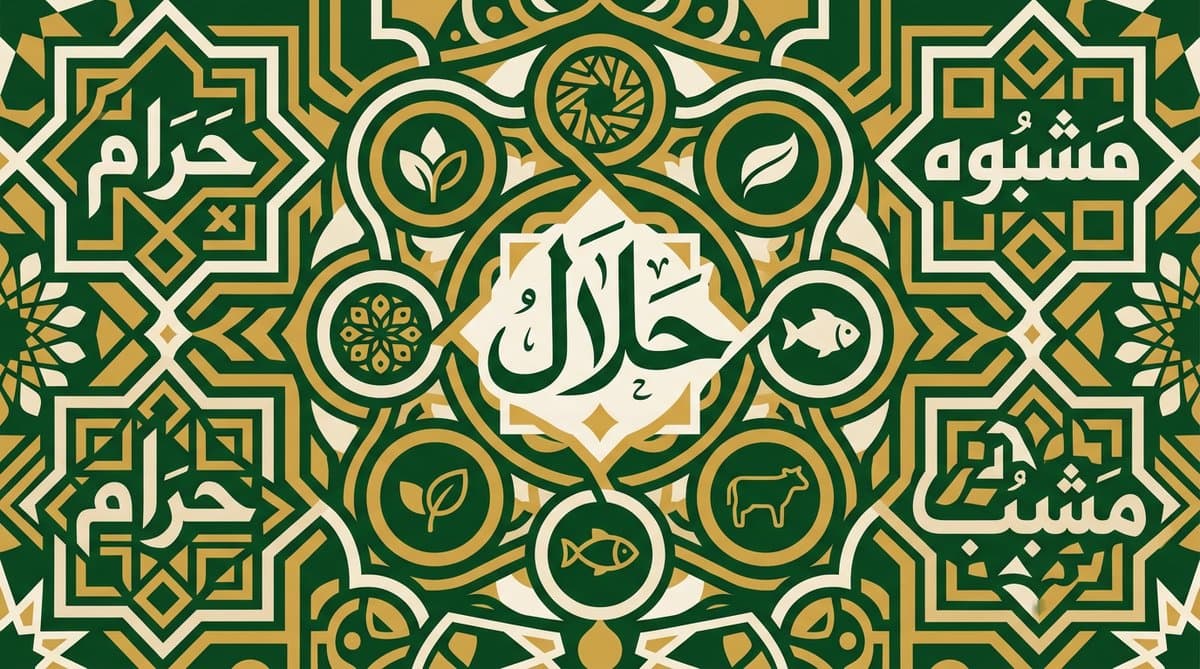
For Muslims around the world, the concept of Halal food goes far beyond simply avoiding pork. It is a comprehensive system of dietary laws rooted in the Quran and the Sunnah (teachings of Prophet Muhammad ﷺ), governing what is permissible to eat and drink. This framework is not just a set of rules but a spiritual practice that promotes mindfulness, gratitude, and physical and spiritual well-being. This guide will walk you through the principles of Halal food, clarify common misconceptions, and provide practical tips for navigating dietary choices in a conscious and faithful way.
The Divine Foundation of Halal and Haram
The terms ‘Halal’ and ‘Haram’ are central to Islamic life, defining what is permissible and forbidden, respectively. The foundation for these dietary laws comes directly from Allah in the Quran. Allah says, « O you who have believed, eat from the good things which We have provided for you and be grateful to Allah if it is [indeed] Him that you worship. » (Surah Al-Baqarah, verse 172). This verse establishes a key principle: Muslims are encouraged to enjoy the bounties of the earth, provided they are ‘tayyib’—good, pure, and wholesome.
The core principle in Islamic jurisprudence is that everything is considered Halal unless it is explicitly declared Haram by a clear text from the Quran or an authentic Hadith. This makes the list of forbidden items relatively short and specific, allowing Muslims a wide variety of foods to enjoy. The prohibitions are not arbitrary; they are divinely legislated for the benefit of humanity, protecting believers from what is spiritually and physically harmful. You can explore these divine injunctions directly in the complete Quran available on Al Muslim Plus, which offers translations and tafsir to deepen your understanding.
Defining Halal, Haram, and Mashbooh
Understanding these three categories is essential for making informed dietary choices.
* **Halal (حَلَال):** This Arabic word means ‘permissible’ or ‘lawful’. In the context of food, it refers to any food or drink that is allowed for consumption under Islamic law. This includes all plant-based foods, most seafood, and meat from permissible animals slaughtered according to Islamic rites.
* **Haram (حَرَام):** This means ‘forbidden’ or ‘unlawful’. These are items explicitly prohibited by Allah. Consuming Haram items is a sin and is considered detrimental to a person’s spiritual health. Examples include pork, alcohol, and blood.
* **Mashbooh (مَشْبُوه):** This term refers to things that are ‘doubtful’ or ‘questionable’. If the source of a food item or its ingredients are unclear, it falls into this gray area. The prophetic guidance is to avoid Mashbooh items to protect one’s faith and integrity. The Prophet Muhammad ﷺ said, « That which is lawful is clear, and that which is unlawful is clear, and between the two of them are doubtful matters about which many people do not know. Thus he who avoids doubtful matters clears himself in regard to his religion and his honor. » (Narrated by Al-Bukhari and Muslim).
A Detailed Breakdown of Prohibited (Haram) Foods
While the range of Halal foods is vast, the list of what is Haram is specific and clear. These prohibitions are laid out in the Quran, most notably in Surah Al-Ma’idah, verse 3. Understanding these categories is the first step to maintaining a Halal diet. Below is a summary of the primary categories of forbidden foods and drinks.
Primary Haram Categories in Islam
| Category | Description and Examples |
|---|---|
| Pork and its By-products | This is the most widely known prohibition. It includes all parts of the pig and any ingredient derived from it, such as lard, gelatin (unless from a Halal source), pepsin, and certain emulsifiers. |
| Blood | Flowing blood from an animal is strictly forbidden. The Islamic method of slaughter is designed to drain the maximum amount of blood from the carcass, which also has hygienic benefits. |
| Carrion (Al-Maytah) | This refers to the meat of any animal that dies of itself, from disease, old age, or an accident (e.g., strangulation, a violent blow, a fall). It must be slaughtered while alive. |
| Animals Slaughtered Without Mentioning Allah’s Name | Meat from a Halal animal becomes Haram if it is slaughtered for an idol or without the name of Allah being pronounced at the time of slaughter (Tasmiyah). |
| Carnivorous Animals and Birds of Prey | Animals that hunt with fangs, such as lions, tigers, and dogs, are Haram. Similarly, birds that hunt with talons, like eagles and hawks, are also forbidden. |
| Reptiles, Amphibians, and Pests | Generally, animals considered repulsive, such as snakes, crocodiles, lizards, rats, and insects (with some exceptions like locusts), are not permissible. |
| Intoxicants (Al-Khamr) | This includes alcohol and any other substance that intoxicates the mind. The prohibition extends to using it as an ingredient in cooking (e.g., wine sauces, vanilla extract with alcohol) or in drinks, even in small amounts. |
It is crucial for Muslims to be diligent in checking ingredient labels for hidden Haram components. Many modern processed foods contain additives and enzymes from non-Halal sources. For a deeper study of these rules, you can consult authentic prophetic traditions in our Hadiths collection, which provides context and explanations for these divine laws.
The Islamic Method of Slaughter (Dhabiha)
For the meat of a permissible animal (like a cow, sheep, or chicken) to be considered Halal, it must be slaughtered in a specific manner known as *Dhabiha*. This method is not merely a ritual but a process prescribed by Allah to ensure the meat is pure, hygienic, and that the animal is treated with respect and mercy. The conditions of Dhabiha are precise and reflect the deep ethics of animal welfare embedded in Islam. The Prophet Muhammad ﷺ emphasized kindness to all of creation, and this principle is paramount during the slaughtering process.
Key Conditions of a Valid Dhabiha
Several conditions must be met for the slaughter to be valid according to Islamic law:
1. **The Slaughterer:** The person performing the slaughter must be a sane adult who is a Muslim, or from the People of the Book (a Christian or a Jew). This allowance is mentioned in the Quran (Surah Al-Ma’idah, verse 5).
2. **The Intention and Invocation (Tasmiyah):** The name of Allah must be invoked at the moment of slaughter. This is typically done by saying « Bismillah, Allahu Akbar » (In the name of Allah, Allah is the Greatest). This act signifies that the life is being taken by Allah’s permission and for the purpose of sustenance, not for sport or cruelty.
3. **The Instrument:** The knife used must be extremely sharp to ensure the cut is swift and painless, minimizing suffering. A dull knife would cause unnecessary pain, which is forbidden.
4. **The Method of Cutting:** The slaughterer must make a quick and deep incision that cuts the trachea (windpipe), esophagus (gullet), and the two jugular veins and carotid arteries. This method causes a rapid drop in blood pressure to the brain, leading to an immediate loss of consciousness and ensuring the animal does not feel pain during the process of bleeding out. Draining the blood completely is also crucial for the purity and quality of the meat.
Humane Treatment in Islam
The Sunnah of Prophet Muhammad ﷺ is filled with instructions on treating animals humanely. These ethics are an integral part of Dhabiha. The animal should be given water and made comfortable before slaughter. It should not be sharpened in front of the animal, and one animal should not be slaughtered in the sight of another. These practices are designed to reduce the animal’s fear and stress, reflecting the compassion that is central to the Islamic faith. The Prophet ﷺ said, « Verily Allah has prescribed ihsan (perfection, excellence) in all things. So if you kill, then kill well; and if you slaughter, then slaughter well. Let one of you sharpen his blade and spare suffering to the animal he slaughters. » (Narrated by Muslim).
Navigating Halal in the Modern World
In today’s globalized food market, identifying Halal food can be challenging due to complex supply chains and processed ingredients. This is where Halal certification bodies play a crucial role. They inspect and certify products, restaurants, and food manufacturers to ensure they comply with Islamic dietary standards from farm to table. Seeing a recognized Halal logo on a product provides a level of assurance for Muslim consumers.
Understanding Halal Certification
A Halal certification logo signifies that a third-party organization has audited the product’s ingredients, production process, and handling procedures to confirm they meet Halal requirements. However, there is no single, universal Halal standard, and different certifiers may have slightly different criteria (for example, regarding the permissibility of mechanical slaughter or stunning). It is wise for consumers to familiarize themselves with the reputable certification bodies in their region. When in doubt about a specific ingredient or a certification logo, you can use helpful resources like the Al Muslim Plus Islamic AI to get answers based on Quran and Sunnah.
Practical Tips for Shopping and Dining
Maintaining a Halal diet requires diligence and awareness. Here are some practical tips:
* **Read Labels Carefully:** Always check the ingredient list on packaged foods. Be wary of ambiguous terms like ‘natural flavors’, ‘broth’, or ‘enzymes’, as they could be derived from Haram sources. Look for ingredients like gelatin, carmine (a red dye from insects), whey powder (rennet source can be an issue), and emulsifiers like E471/E472 (mono- and diglycerides), which can be of animal or plant origin.
* **Ask Questions When Dining Out:** If a restaurant claims to be Halal, don’t hesitate to ask which certifier they use or where they source their meat. Be cautious of cross-contamination, where Halal and non-Halal foods are cooked using the same utensils or surfaces.
* **Find Halal Options:** In many cities, Halal restaurants and butcher shops are concentrated in certain areas. Using a tool like a Mosque Finder can often lead you to communities where Halal establishments are more common and easily accessible.
* **Cook at Home:** The surest way to guarantee your food is Halal is to prepare it yourself. This gives you full control over every ingredient and cooking method.
Frequently Asked Questions
Is all seafood considered Halal in Islam?
According to the majority of Sunni schools of thought, all fish with scales and most other creatures from the sea are Halal. The Quran states, « Lawful to you is game from the sea and its food as provision for you… » (Surah Al-Ma’idah, 96). However, there are some differences of opinion among scholars regarding animals like crabs, shellfish, and squid.
What is the main difference between Halal and Kosher?
Halal and Kosher (Jewish dietary laws) share many similarities, such as the prohibition of pork and blood and the use of ritual slaughter. Key differences include the fact that Islam permits shellfish while Judaism forbids it, and Kosher laws have stricter rules about not mixing meat and dairy. Additionally, Islam allows for the meat slaughtered by Christians and Jews to be consumed.
Can Muslims eat food cooked by a non-Muslim?
Yes, Muslims can eat food prepared by non-Muslims, provided the food itself is Halal. The faith of the cook does not make the food Haram. The critical factor is that the ingredients are permissible and there is no cross-contamination with Haram substances like pork or alcohol.
Is stunning animals before slaughter permitted in Islam?
This is a topic of debate among Islamic scholars. Some scholars permit stunning if it is reversible and only renders the animal unconscious without killing it before the slaughter is performed. Others argue that it is best to avoid it, as it risks the animal dying before the cut is made, which would render it Haram.
How can I be sure a product with a Halal logo is genuinely Halal?
To ensure authenticity, it’s best to become familiar with the well-known and respected Halal certification bodies in your country or region. You can often check the certifier’s website to see if the brand is listed as one of their clients. Be cautious of unfamiliar or self-made logos without a credible organization behind them.
What does the term ‘Tayyib’ mean in relation to Halal food?
Tayyib means ‘good’, ‘pure’, ‘wholesome’, or ‘ethical’. The Quran often pairs Halal with Tayyib, indicating that food should not only be permissible but also of high quality and produced ethically. This extends to how animals are raised and how crops are grown, encouraging Muslims to seek out food that is both lawful and wholesome.
Is gelatin always Haram?
Gelatin is Haram if it is derived from pigs. If it is derived from cows or other Halal animals that were not slaughtered according to Islamic law, it is also considered Haram by most scholars. Gelatin from a Halal-slaughtered animal, from fish, or from plant sources (like agar-agar) is Halal.
The Islamic dietary laws are a beautiful expression of faith that intertwines spiritual consciousness with daily consumption. Choosing Halal food is an act of obedience and gratitude to Allah, promoting a lifestyle that is pure, ethical, and beneficial for the body and soul. By understanding the principles of Halal and Haram, we can navigate our choices with confidence and transform the simple act of eating into a rewarding form of worship. For further guidance on your spiritual journey and practical tools to support your Islamic lifestyle, download the Al Muslim Plus app today.