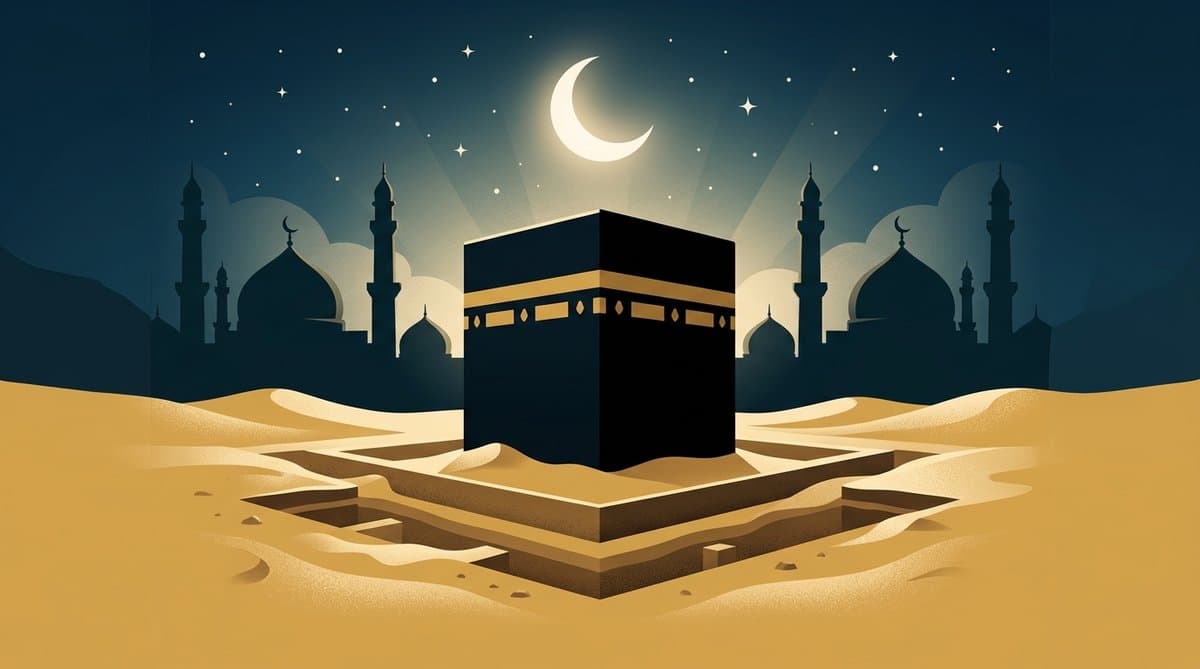
The Kaaba, the simple black cube standing in the center of the Grand Mosque in Mecca, is the heart of Islam. For over 1.8 billion Muslims, it is the qibla—the single direction they face in prayer five times a day, a powerful symbol of unity and devotion. But what is the history of the Kaaba? This ancient structure’s story is deeply woven into the fabric of Islamic tradition, stretching back to the dawn of humanity and marking pivotal moments in the lives of the prophets. This article unravels its sacred history, from its primordial origins to its central role in the Muslim world today.
The Primordial Origins: Adam and the First House of Worship
Islamic tradition teaches that the history of the Kaaba begins not with Prophet Ibrahim (peace be upon him), but with the very first human, Prophet Adam (peace be upon him). After being sent to Earth, it is believed that Adam built the first structure dedicated to the singular worship of Allah. The Quran refers to the Kaaba’s ancient roots, stating, « Indeed, the first House [of worship] established for mankind was that at Bakkah [Mecca] – blessed and a guidance for the worlds. » (Surah Al ‘Imran, verse 96). This verse underscores its status as the original center for monotheistic worship on Earth.
This primordial Kaaba stood as a beacon of Tawhid (the oneness of God) for generations. However, over the vast expanse of time, the original structure was lost. Islamic scholars narrate that the great flood during the time of Prophet Nuh (Noah, peace be upon him) erased most of the world’s landmarks, and the House of Allah was no exception, its foundations buried beneath the sands of the Arabian valley. For centuries, its location was forgotten, though the sanctity of the area remained, waiting to be revived by divine command.
The concept of a ‘first house’ is profound. It establishes that humanity’s natural state (fitra) is to worship one Creator. The Kaaba is not merely a building but a symbol of this innate human connection to the divine, a physical anchor for a spiritual truth that transcends time. Its story is a recurring cycle of renewal: built for pure worship, lost to time or corrupted by human hands, and then restored to its original purpose by the prophets of Allah.
The Great Reconstruction by Prophet Ibrahim and Ismail (peace be upon them)
Centuries after the flood, the history of the Kaaba entered its most defining chapter. Allah commanded Prophet Ibrahim (Abraham, peace be upon him), the great patriarch of monotheism, to leave his wife Hajar and infant son, Ismail (Ishmael, peace be upon him), in the barren, uninhabited valley of Mecca. This profound test of faith led to the miracle of the well of Zamzam and the establishment of a settlement in this blessed land. Years later, Allah commanded Ibrahim to return to Mecca for an even greater task: to rebuild the House of God upon its original, ancient foundations.
The Quran beautifully documents this monumental father-son project. « And [mention] when Abraham was raising the foundations of the House and [with him] Ishmael, [saying], ‘Our Lord, accept [this] from us. Indeed You are the Hearing, the Knowing.' » (Surah Al-Baqarah, verse 127). Working together, they raised the walls of the Kaaba. It was a humble, roofless, rectangular structure, built from the stones of the surrounding hills. As Ibrahim built higher, he stood upon a special stone, the Maqam Ibrahim (Station of Ibrahim), which miraculously rose to aid him. His footprints are said to be preserved in this stone to this day, a cherished relic near the Kaaba.
Their physical labor was intertwined with deep spiritual devotion. As they built, they prayed not for worldly reward but for Allah’s acceptance and for the future of their descendants. They asked Allah to make them a nation submitted to Him and to send a messenger from among them—a prayer that would be answered centuries later with the arrival of Prophet Muhammad ﷺ. This reconstruction firmly established the Kaaba as the epicenter of pure monotheism, a legacy you can explore further in the stories of the 25 prophets mentioned in the Quran available on Al Muslim Plus.
Guardianship, Idolatry, and the Quraysh Reconstruction
Following the time of Ibrahim and Ismail (peace be upon them), the guardianship of the Kaaba was passed down through generations. Mecca grew into a thriving trade hub, and the Kaaba’s sanctity brought it great prestige. Unfortunately, as centuries passed, the purity of its purpose was slowly corrupted. Influenced by travelers and surrounding cultures, the Arabs began to introduce idols into the sacred house. What was once a symbol of pure Tawhid became a sanctuary for polytheism, eventually housing up to 360 different idols representing various tribes and deities.
Despite this spiritual deviation, the tribe of Quraysh, the descendants of Prophet Ismail, held the esteemed position of custodians of the Kaaba. This role gave them immense social, political, and economic power in Arabia. Around the year 605 CE, just a few years before Prophet Muhammad ﷺ received his first revelation, the Kaaba was severely damaged by a major flood and a subsequent fire, necessitating a complete rebuild. The various clans of Quraysh worked together on the reconstruction, but when it came time to place the sacred Black Stone (al-Hajar al-Aswad) back in its corner, a fierce dispute broke out. Each clan leader wanted the singular honor, and the conflict escalated to the brink of bloodshed.
It was then that the wisdom of a young Muhammad ﷺ, known even before his prophethood as ‘Al-Amin’ (the Trustworthy), saved the day. The elders agreed to let the next person who entered the sanctuary arbitrate. That person was Muhammad ﷺ. He proposed a brilliant and simple solution: he placed the stone on a cloak and had a representative from each clan hold a corner of the cloak to lift it together. He then took the stone with his own blessed hands and set it in its place. This event not only prevented a war but also foreshadowed his future role as a unifier and leader. For Muslims today, the Kaaba remains the unchanging point of unity, and a tool like a Qibla compass ensures every prayer is aligned toward this sacred center.
The Prophetic Era: Purification and Final Status
The ultimate restoration of the Kaaba to its Abrahamic purpose came with the advent of Islam. For the first 13 years of his mission in Mecca, Prophet Muhammad ﷺ and the early Muslims faced intense persecution, often barred from worshipping at the Kaaba. After the Hijra (migration) to Medina, the qibla was temporarily directed towards Jerusalem. Then, a divine revelation instructed the Prophet ﷺ to turn back towards the Kaaba in Mecca, permanently establishing it as the direction of prayer for all Muslims. This act spiritually reconnected the new Muslim community with the legacy of Prophet Ibrahim (peace be upon him).
The physical purification of the Kaaba occurred in 8 AH (630 CE) during the triumphant and peaceful conquest of Mecca. One of the first things Prophet Muhammad ﷺ did upon entering the city was to go to the Kaaba. He circumambulated it and, using his staff, pointed to each of the 360 idols, causing them to fall as he recited the Quranic verse: « And say, ‘Truth has come, and falsehood has departed. Indeed is falsehood, [by nature], ever bound to depart.' » (Surah Al-Isra, verse 81). This powerful act cleansed the House of Allah from all traces of polytheism, rededicating it solely to the worship of the One God, just as Ibrahim had intended.
Since that day, the Kaaba has remained the spiritual heart of the Muslim world. It has undergone several repairs and expansions over the centuries by various Caliphs and rulers, most notably the massive expansions by the Saudi government to accommodate the millions of pilgrims who visit for Hajj and Umrah. Yet, its core structure and profound spiritual significance have remained untouched. It stands today as the ultimate symbol of Islamic unity, the focal point of daily worship, and the destination of a lifetime journey for which a step-by-step Hajj & Umrah guide is an invaluable companion for every pilgrim.
Understanding the Kaaba’s Sacred Elements
The Kaaba, while simple in its cubic form, is composed of several elements, each holding deep historical and spiritual significance for Muslims.
Al-Hajar al-Aswad (The Black Stone)
Set in the eastern corner of the Kaaba, the Black Stone is arguably its most famous feature. Islamic tradition teaches that it descended from Paradise and was originally pure white, but turned black from absorbing the sins of humanity. It is not an object of worship. Rather, it serves as the starting and ending point for the Tawaf (the seven circumambulations). The practice of touching or kissing it, if possible, is a Sunnah (practice of the Prophet ﷺ). The famous words of Umar ibn al-Khattab encapsulate its status perfectly: « I know that you are a stone and can neither benefit nor harm. Had I not seen the Messenger of Allah ﷺ kissing you, I would not have kissed you. » (Narrated by Al-Bukhari).
The Kiswah (The Covering)
The Kaaba is draped in a magnificent black silk cloth known as the Kiswah. This covering is intricately embroidered with gold and silver thread, featuring Quranic verses and declarations of faith. The tradition of covering the Kaaba is ancient, predating Islam. Today, the Kiswah is manufactured in a special factory in Mecca and is replaced annually on the 9th day of Dhul Hijjah, the day pilgrims leave for the plains of Arafat during Hajj. The old Kiswah is cut into pieces and given as gifts to dignitaries and organizations.
Maqam Ibrahim (The Station of Ibrahim)
Located a few meters from the Kaaba is a glass and metal enclosure containing a stone bearing the footprints of Prophet Ibrahim (peace be upon him). It is believed that he stood on this stone while building the upper parts of the Kaaba. The Quran designates it as a place of prayer: « And take, [O believers], from the standing place of Abraham a place of prayer. » (Surah Al-Baqarah, verse 125). After completing their Tawaf, pilgrims are encouraged to perform a two-rak’ah prayer behind the Maqam Ibrahim.
Hijr Ismail (The Enclosure of Ismail)
Adjacent to the Kaaba is a semi-circular, low wall known as the Hatim. This area, the Hijr Ismail, is believed to be the location of the shelter built by Prophet Ismail (peace be upon him) for his mother Hajar and himself. Importantly, Islamic tradition holds that this area was part of the original Kaaba built by Ibrahim. Therefore, performing prayer inside the Hijr Ismail is considered as meritorious as praying inside the Kaaba itself. During Tawaf, pilgrims must walk around the outside of this wall, as it is part of the sacred house.
Frequently Asked Questions
Who built the Kaaba first?
Islamic tradition holds that the Kaaba was first built by Prophet Adam (peace be upon him) as the first house of worship on Earth. It was later rebuilt on its original foundations by Prophet Ibrahim and his son Ismail (peace be upon them) after it was lost over time.
Why do Muslims pray towards the Kaaba?
Muslims pray towards the Kaaba as a unified direction (Qibla) commanded by Allah in the Quran (Surah Al-Baqarah, verse 144). It is not worship of the structure itself, but a powerful symbol of the unity of all Muslims in their submission to the One God.
Is the Black Stone an idol?
No, the Black Stone is not an idol and is not worshipped by Muslims. It serves only as a starting marker for the Tawaf (circumambulation) and is revered because Prophet Muhammad ﷺ touched and kissed it, making it a part of his Sunnah (prophetic practice).
What is inside the Kaaba?
The interior of the Kaaba is simple and largely empty. It contains three wooden pillars to support the roof, a small table for placing perfume or incense, and walls inlaid with marble. Its emptiness powerfully symbolizes that worship is directed to Allah alone, not to any object, image, or intermediary.
Can non-Muslims enter Mecca and the Kaaba?
Entry into the holy city of Mecca, and by extension the Kaaba, is restricted to Muslims. This practice is based on Quranic guidance and serves to preserve the sanctity and spiritual atmosphere of Islam’s most sacred sites for worshippers.
Has the Kaaba ever been damaged or destroyed?
Yes, the Kaaba has been damaged and reconstructed multiple times throughout its long history due to natural disasters like floods and human conflicts. However, its original foundations laid by Prophet Ibrahim (peace be upon him) are considered divinely protected and have remained the basis for every reconstruction.
Why is the Kaaba covered with a black cloth?
The black cloth is called the Kiswah and it signifies the great honor and reverence held for the Kaaba. The tradition of covering it is ancient, and while colors have varied historically, the black silk with gold embroidery has been the standard for centuries, replaced annually during the Hajj pilgrimage.
The history of the Kaaba is the history of humanity’s relationship with God. From its first foundation by Adam to its reconstruction by Ibrahim and its final purification by Muhammad ﷺ, the Kaaba has remained a constant, physical testament to the enduring message of Tawhid. It is more than a building of stone; it is a symbol of unity, a direction for prayer, and a destination that stirs the soul of every Muslim. Its story reminds us that our faith is built upon a legacy of prophets who dedicated their lives to calling humanity back to the worship of the one true God. To deepen your understanding of this rich heritage and strengthen your own spiritual practices, explore the comprehensive resources available on the Al Muslim Plus app.