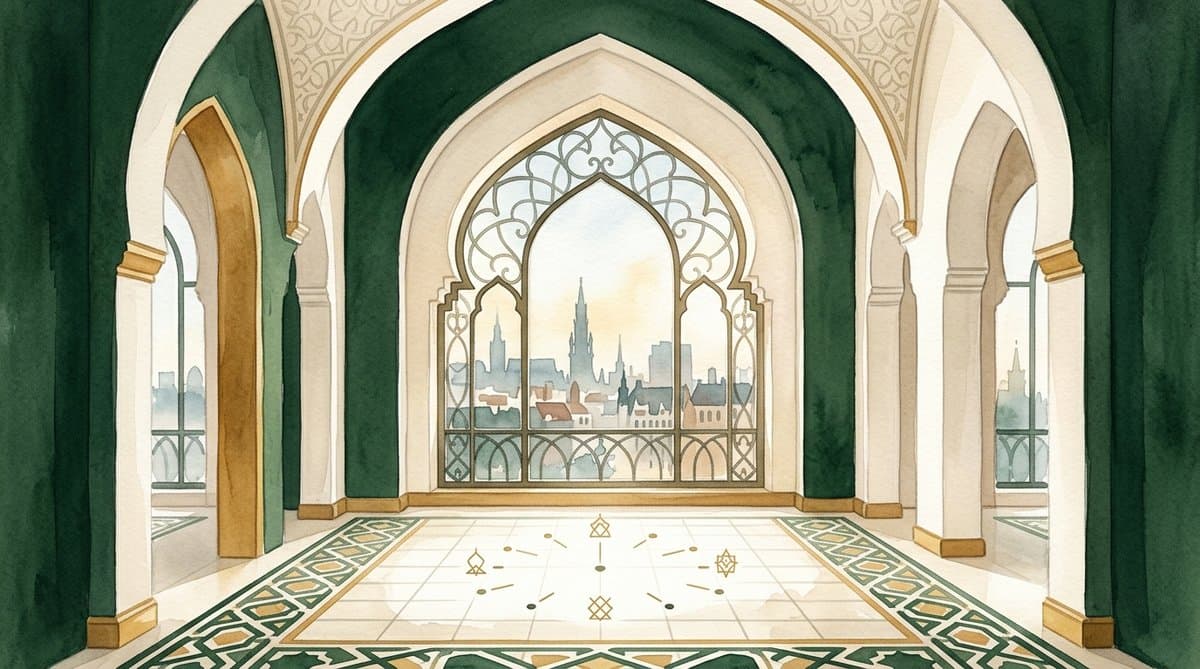
As the blessed month of Ramadan concludes, a gentle quiet settles in, leaving behind a renewed sense of spiritual discipline. For Muslims in the vibrant, fast-paced capital of Brussels, the challenge is to carry this tranquility forward. The five daily prayers (Salah) are the pillars that uphold this connection to Allah, and having access to reliable ‘horaires priere Bruxelles’ is not just a matter of logistics; it is the key to maintaining a rhythm of peace and mindfulness amidst the demands of daily life. This guide is dedicated to helping you establish and maintain your prayer routine, turning each call to prayer into a cherished appointment with the Divine.
The Spiritual Rhythm of Salah in a Bustling European Capital
Salah is more than a ritual; it is a direct conversation with Allah, a spiritual anchor that grounds a Muslim five times a day. The Quran emphasizes its importance, stating, « Indeed, prayer has been decreed upon the believers a decree of specified times » (Surah An-Nisa, verse 103). This divine schedule creates a rhythm that structures our day around our ultimate purpose, rather than letting our worldly tasks dictate our spiritual life. In a city like Brussels, where life moves quickly and the public call to prayer (Adhan) is not a common feature of the soundscape, the responsibility to be punctual with Salah falls squarely on the individual.
Each prayer offers a unique spiritual reset. Fajr begins the day with remembrance before the world awakens. Dhuhr provides a midday pause to seek guidance and strength. Asr is a moment of reflection in the late afternoon, a reminder of the fleeting nature of time. Maghrib welcomes the evening with gratitude, and Isha concludes the day with a plea for forgiveness and peace. Embracing these moments allows a Muslim to navigate the pressures of urban life with a heart tethered to faith. It transforms the city’s hustle from a source of stress into a backdrop for consistent, mindful worship. The key is knowing precisely when these sacred moments occur each day.
Finding Serenity in a Structured Routine
The structure of the five daily prayers is a mercy from Allah. It prevents our spiritual obligations from becoming an afterthought, easily forgotten in the rush of deadlines, commutes, and social commitments. By consciously planning our day around the ‘horaires priere Bruxelles’, we prioritize our relationship with our Creator. This discipline fosters a sense of inner peace that external circumstances cannot easily disturb. It is a practical demonstration of the hadith where the Prophet Muhammad ﷺ told Bilal, « O Bilal, call the Iqamah for prayer, relieve us with it. » (Narrated by Abu Dawud). Prayer is not a burden; it is our relief and our sanctuary.
Understanding Prayer Time Calculations in Brussels
Prayer times are not arbitrary; they are determined by the position of the sun, which is why they vary daily and by location. For a city at the latitude of Brussels, these calculations require a clear methodology. The times for Fajr (dawn), Dhuhr (midday), Asr (afternoon), Maghrib (sunset), and Isha (night) are calculated based on specific astronomical angles. In Belgium, many mosques and Islamic organizations, including the Muslim Executive of Belgium (Exécutif des Musulmans de Belgique), often adopt a standard calculation method to ensure uniformity for the community. A widely used convention is the 18-degree angle for Fajr and the 17-degree angle for Isha, though variations exist.
Understanding what each prayer time signifies is crucial. Fajr begins at true dawn, when the first light appears on the horizon, and ends at sunrise. Dhuhr starts just after the sun passes its zenith. Asr time begins when the length of an object’s shadow is equal to its height plus the length of its shadow at noon. Maghrib starts immediately after sunset, and Isha begins when the twilight has completely disappeared. For daily updated and precise timings, you can always check the accurate prayer times for Brussels on our platform, which provides reliable calculations tailored to your exact location.
| Prayer (Salah) | Time Period | Spiritual Significance |
|---|---|---|
| Fajr (Dawn Prayer) | From dawn until sunrise | Starting the day with the remembrance of Allah, seeking blessings and protection. |
| Dhuhr (Midday Prayer) | After the sun passes its zenith until Asr | A break from worldly affairs to reconnect with the Creator and seek guidance. |
| Asr (Afternoon Prayer) | From mid-afternoon until sunset | A reminder of the passage of time and the importance of patience and steadfastness. |
| Maghrib (Sunset Prayer) | Just after sunset until Isha | A moment of gratitude for the day’s blessings and seeking forgiveness. |
| Isha (Night Prayer) | When darkness falls until midnight | Concluding the day with submission to Allah, finding peace before rest. |
The Muslim Community and Mosques in Brussels
Brussels is home to a large, dynamic, and diverse Muslim community, with roots stretching from Morocco and Turkey to Pakistan, Sub-Saharan Africa, and beyond. This rich tapestry of cultures has given rise to a vibrant Islamic life in the heart of Europe. Mosques (masjids) are the focal points of this community, serving not only as places of worship but also as centers for education, social gatherings, and mutual support. Praying in congregation (Salat al-Jama’ah) carries immense rewards and strengthens the bonds of brotherhood and sisterhood.
The most prominent Islamic institution is the Grand Mosque of Brussels, located in the Cinquantenaire Park. It has historically served as a central hub for the community and a symbol of Islam’s presence in Belgium. However, the city is dotted with numerous other mosques, each serving its local neighborhood. From the diverse mosques in communes like Molenbeek-Saint-Jean and Schaerbeek to smaller prayer rooms near universities and business districts, there are many opportunities to join in congregational prayer. Before praying, whether at home or in a new mosque, it’s essential to face the Kaaba in Mecca. A reliable Qibla compass ensures you are always correctly oriented for your Salah.
Finding these community hubs is easier than ever. If you’re new to an area, visiting, or simply looking for a place for congregational prayer, using a nearby mosque finder can be incredibly helpful in connecting you with the local community. These spaces offer a chance to listen to khutbahs (sermons), participate in Islamic classes, and feel the collective spirit of the Ummah, which is especially comforting for those living away from their home countries.
Practical Tips for Maintaining Prayer Consistency Post-Ramadan
The spiritual high of Ramadan provides a powerful boost, but the true test of our devotion is consistency in the months that follow. The habits built during the holy month are precious and require conscious effort to maintain. Shaytan (Satan) may whisper that you are too busy or too tired, but with practical strategies, you can safeguard your Salah and keep your spiritual connection strong.
First, leverage technology for good. Set up Adhan notifications on your phone. The sound of the call to prayer, even from a device, can be a powerful trigger that pulls you away from distractions and reminds you of your duty to Allah. Second, designate a specific prayer space in your home. A clean, quiet, and pleasant corner dedicated to worship helps create a mental transition from worldly concerns to spiritual focus. This physical space becomes a personal sanctuary, making it easier to perform your prayers with khushu’ (concentration and humility).
Third, integrate your prayers into your daily schedule. Think of them not as interruptions but as essential appointments. Plan your work breaks, meals, and errands around the ‘horaires priere Bruxelles’. For example, resolve to pray Dhuhr before returning to work after lunch, or perform Asr before starting your evening commute. Finally, monitor your own commitment. To build momentum and visually see your progress, a dedicated prayer tracker can be a powerful motivator. It helps you identify patterns where you might be struggling and encourages you to maintain streaks, reinforcing the discipline you cultivated during Ramadan.
Frequently Asked Questions
What is the most accurate prayer time calculation method for Brussels?
Most mosques and Islamic organizations in Brussels and Belgium use methods based on astronomical angles, often 18 degrees for Fajr and 17 degrees for Isha. The Muslim Executive of Belgium provides a unified calendar, which is a reliable source. Apps like Al Muslim Plus use precise calculations based on these established conventions.
How can I get daily prayer time notifications on my phone in Brussels?
You can download a dedicated Islamic app like Al Muslim Plus. It uses your phone’s GPS to provide accurate prayer times for Brussels and allows you to set up customizable Adhan notifications for each of the five daily prayers, so you never miss one.
Where is the main mosque in Brussels?
The main and most well-known mosque is the Grand Mosque of Brussels, also known as the Islamic and Cultural Centre of Belgium. It is located in the Cinquantenaire Park, close to the Schuman district.
What should I do if I miss a prayer (Salat al-Qada)?
If you miss a prayer unintentionally (e.g., due to sleep or forgetfulness), you should make it up as soon as you remember. This is known as Qada prayer. The scholarly consensus is to pray the missed prayer with the same format as if it were prayed on time.
How is the start of Fajr determined in summer in Brussels when twilight is long?
This is a common issue in northern latitudes. Islamic bodies and scholars have provided solutions, such as using a fixed time, calculating based on the last day when true night occurred, or adopting the prayer times of a more southern city. It’s best to follow the calendar of a trusted local mosque or Islamic authority.
Can I combine Dhuhr and Asr prayers if I am busy?
Combining prayers (Jam’) is a concession allowed in Islam under specific circumstances, such as travel, severe illness, or extreme weather. While some schools of thought permit it for other significant hardships, it should not be made a regular habit for work or study. The principle is to perform each prayer in its designated time.
How do I find the Qibla direction in Brussels?
The Qibla direction from Brussels is approximately 120 degrees southeast. You can use a reliable digital compass, such as the Qibla finder in the Al Muslim Plus app, which uses your phone’s GPS to give you the precise direction of the Kaaba in Mecca.
Observing the five daily prayers on time is the heartbeat of a Muslim’s faith, a constant source of peace, guidance, and connection to Allah. In a dynamic city like Brussels, establishing this divine rhythm requires intention and the right tools. By understanding how prayer times are calculated, connecting with the local community, and adopting practical habits, you can ensure your Salah remains a consistent and cherished pillar of your life. Let your prayers be the peaceful anchors that steady your soul, no matter how busy the day gets.