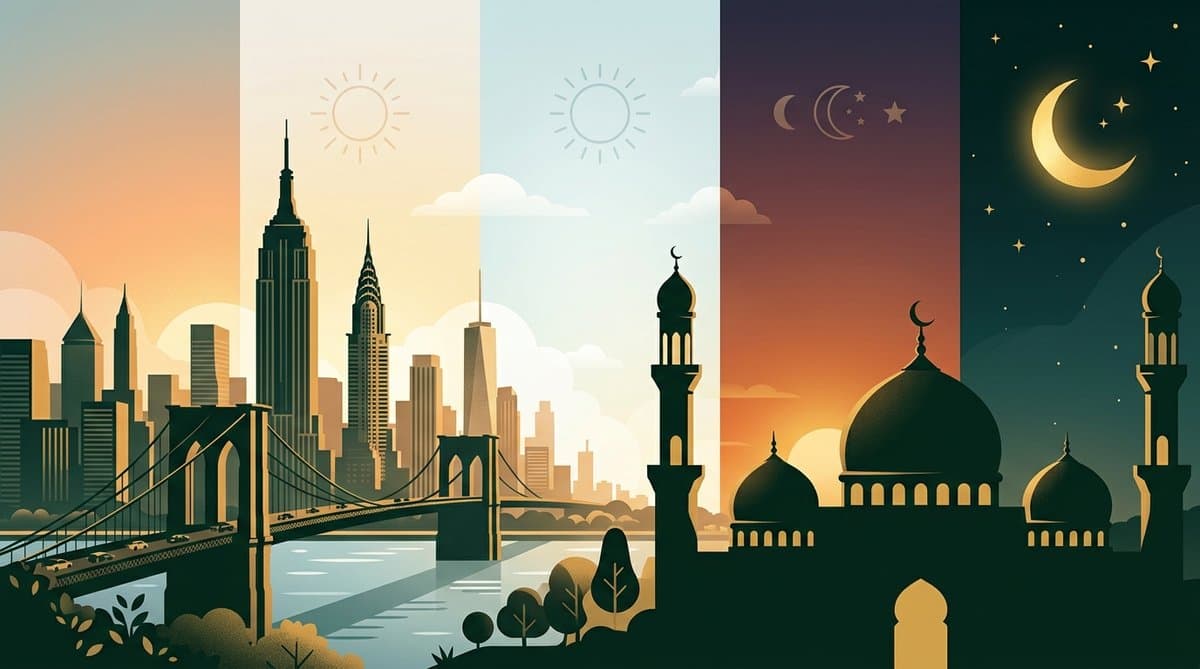
In the vibrant, non-stop rhythm of New York City, from the bustling streets of Manhattan to the diverse neighborhoods of Brooklyn, maintaining a connection to one’s faith is both a challenge and a source of profound peace. For the city’s large and dynamic Muslim community, the five daily prayers (Salah) are the pillars that structure the day, providing moments of tranquility and reflection. Finding accurate ‘horaires priere New York’ is the first crucial step to fulfilling this sacred duty, ensuring that your worship is performed at its prescribed time, no matter where you are in the five boroughs.
The Unwavering Importance of Timely Salah in Islam
Salah is the second pillar of Islam and the most direct connection a Muslim has with Allah (SWT). It is a spiritual obligation that punctuates our daily lives, reminding us of our purpose and bringing us back to our Creator. The Quran emphasizes the importance of performing prayers at their designated times. Allah says, « Indeed, prayer has been decreed upon the believers a decree of specified times » (Surah An-Nisa, verse 103). This verse underscores that punctuality is not merely a suggestion but an integral part of the act of worship itself. Each prayer—Fajr, Dhuhr, Asr, Maghrib, and Isha—has a specific window determined by the position of the sun, a divine clockwork that governs our spiritual routine.
The act of observing Salah on time builds discipline, mindfulness, and a constant awareness of God. It is a spiritual reset, allowing us to pause our worldly pursuits and re-center our intentions. The Prophet Muhammad ﷺ highlighted the virtue of this practice, stating, « The most beloved of deeds to Allah is the prayer offered on time » (Narrated by Al-Bukhari). In a city as demanding as New York, where schedules are tight and distractions are plentiful, adhering to the prayer schedule can feel like an uphill battle. However, the spiritual rewards are immense, fostering a sense of stability and peace amidst the chaos. To help build this crucial habit, consistently logging your prayers can be incredibly motivating. You can use a dedicated Prayer tracker to monitor your progress and build rewarding streaks of consistency.
Understanding the Five Daily Prayer Windows
Each of the five prayers is a unique spiritual experience tied to the natural cycle of the day. Fajr, the dawn prayer, begins at the first light of dawn and ends at sunrise, offering a blessed start to the day. Dhuhr, the noon prayer, is performed after the sun passes its zenith. Asr, the afternoon prayer, takes place late in the afternoon. Maghrib is prayed just after sunset, marking the end of the day’s fast during Ramadan. Finally, Isha, the night prayer, is performed after twilight has disappeared. Understanding these windows is essential for every Muslim, as it forms the basis of our daily worship.
How Prayer Times Are Calculated for New York City
Determining the exact prayer times for a specific location like New York is a science based on astronomical calculations. The timings depend on the city’s latitude (40.7128° N) and longitude (74.0060° W), as well as the time of year, which affects the length of the day and the sun’s trajectory. Several calculation methods exist, developed by different Islamic authorities. For North America, the most widely accepted and commonly used method is that of the Islamic Society of North America (ISNA). This method specifies the angles for Fajr (15 degrees below the horizon) and Isha (15 degrees below the horizon), which are used to calculate the start of these prayer times.
Another factor unique to places like New York is Daylight Saving Time (DST). When the clocks spring forward in March, prayer times also shift an hour later, and they shift back again in November. This can cause confusion if one is relying on a printed, static calendar. An error of even a few minutes can mean the difference between praying on time or missing the prescribed window. This is why using a reliable, location-aware application is paramount for Muslims in NYC. Al Muslim Plus automatically adjusts for all these variables—calculation method, geographical coordinates, and DST—to provide you with the most precise horaires priere for New York City, updated daily for your peace of mind.
The Vibrant Muslim Community and Mosques of NYC
New York City is home to one of the most diverse Muslim populations in the world, with communities hailing from every corner of the globe. This rich tapestry is reflected in the city’s hundreds of mosques, or masjids, which serve as spiritual, educational, and community hubs. Each borough has its landmark Islamic centers that welcome worshippers for daily prayers, Jumu’ah (Friday prayer), and community events. Praying in congregation holds special rewards, and visiting these masjids is a beautiful way to connect with the local Ummah.
In Manhattan, the Islamic Cultural Center of New York on 96th Street stands as an architectural landmark, while the historic Masjid Malcolm Shabazz in Harlem has a deep-rooted history in the African-American Muslim community. Brooklyn is home to vibrant communities served by masjids like Masjid At-Taqwa and Makki Masjid. In Queens, the Muslim Center of New York and Masjid Al-Falah are central to their neighborhoods. The Bronx and Staten Island also have numerous masjids serving their growing Muslim populations. While these centers are invaluable, it’s not always possible to reach one for every prayer. For those moments when you’re exploring a new neighborhood or simply need to find the closest place to pray, a digital Mosque finder can be an indispensable tool, guiding you to the nearest masjid with ease.
Finding a Place for Salah On-the-Go
Beyond official mosques, New York City offers many quiet spaces for prayer if you know where to look. Many universities, like NYU and Columbia, have dedicated interfaith prayer rooms. Major airports like JFK and LaGuardia also have chapels or quiet rooms available for travelers. Even a quiet corner of a public park, such as Central Park or Prospect Park, can serve as a place for reflection and prayer, provided you can perform wudu (ablution) beforehand. The key is to be prepared and aware of your surroundings.
Practical Tips for Maintaining Your Prayers in the City
Integrating five daily prayers into a fast-paced New York lifestyle requires intention and practical planning. One of the biggest challenges, especially within the towering skyscrapers of Manhattan, is determining the correct direction of the Kaaba in Mecca for prayer. The city’s grid system can be disorienting, and guessing the direction is not advisable when accuracy is required for the validity of Salah. Using a reliable digital compass is essential. The Al Muslim Plus app includes an easy-to-use Qibla compass that works anywhere, instantly showing you the correct direction from your exact location, whether you’re in an office in Times Square or a cafe in Greenwich Village.
Making wudu can also be a challenge. Public restrooms are readily available, but it helps to be discreet and efficient. Using a water bottle can be a practical alternative if facilities are not ideal. In terms of scheduling, it’s helpful to block out 10-15 minute slots in your digital calendar for each prayer. Setting notifications on your phone for the adhan (call to prayer) ensures you are reminded before the prayer window closes. By combining proactive planning with modern tools, any Muslim can successfully weave their spiritual obligations into their daily New York life, transforming the city’s challenges into opportunities for greater devotion.
A Sample Islamic Prayer Schedule for New York City
To put everything into perspective, let’s visualize a typical day’s prayer schedule in New York. The exact times fluctuate daily, so always check a reliable source for the current day’s timings. Below is an example schedule for today, April 1, 2026. These timings are calculated based on the ISNA method, which is standard for the region.
| Prayer | Time in NYC (April 1, 2026) | Spiritual Focus |
|---|---|---|
| Fajr | 5:15 AM | Starting the day with gratitude and seeking Allah’s guidance. |
| Dhuhr | 12:59 PM | A midday pause to remember Allah amidst work or studies. |
| Asr | 4:37 PM | A moment of reflection in the late afternoon before the day winds down. |
| Maghrib | 7:18 PM | Breaking the day’s spiritual journey at sunset and showing thankfulness. |
| Isha | 8:35 PM | Ending the day with repentance and preparing for a peaceful night. |
Imagine starting your day with Fajr before the city fully awakens, finding a quiet moment for Dhuhr during your lunch break, and catching Asr before heading home. Maghrib arrives as the city lights begin to twinkle, and Isha provides a final, peaceful connection with Allah before rest. After each prayer, it is a beautiful practice to make personal supplications. For inspiration, you can explore a categorized collection of authentic Supplications (Duas) for various occasions, from seeking knowledge to expressing gratitude.
Frequently Asked Questions
What is the most accurate prayer time calculation method for New York?
The most widely used and accepted method for New York and across North America is the one established by the Islamic Society of North America (ISNA). Al Muslim Plus uses this method to ensure you get the most accurate local prayer times.
Do prayer times change during daylight saving in NYC?
Yes, they do. When Daylight Saving Time begins in the spring, the clocks move forward one hour, and so do all the prayer times. They shift back an hour in the fall. A reliable prayer app will make these adjustments automatically.
Is it acceptable to pray in public spaces in New York City?
Yes, it is generally acceptable to pray in public in NYC, provided you do so respectfully and in a way that doesn’t obstruct others. Many people find quiet corners in parks, public squares, or university campuses to perform their prayers.
How can I find the Qibla direction in NYC without a physical compass?
The most reliable way is to use a GPS-enabled mobile application. The Al Muslim Plus app has a built-in Qibla compass that uses your phone’s location to point you directly towards the Kaaba in Mecca, eliminating all guesswork.
What is the prayer time difference between Brooklyn and Manhattan?
The difference is negligible, usually less than a minute. Because they are geographically very close, the timings for Fajr, Dhuhr, Asr, Maghrib, and Isha are virtually identical. A location-based app will provide the precise time for your exact spot.
How do I get notifications for prayer times on my phone?
You can receive automatic alerts for the Adhan (call to prayer) by downloading a Muslim lifestyle app like Al Muslim Plus. Simply enable notifications in the app’s settings and select your preferred alert sound.
Are there many halal food options near major mosques in NYC?
Absolutely. New York City is famous for its diverse culinary scene, and areas with large Muslim communities, especially around major mosques in Queens, Brooklyn, and Manhattan, have an abundance of halal restaurants, cafes, and grocers.
Living as a Muslim in New York City is a unique and rewarding experience. While the city’s pace can be demanding, the tools and resources available today make it easier than ever to stay connected to the foundational practices of our faith. By understanding how prayer times are calculated, knowing where to find community, and using reliable digital aids, you can master your daily Salah schedule and find spiritual balance. Let your prayers be a source of strength and tranquility that anchors you, no matter what the city throws your way.