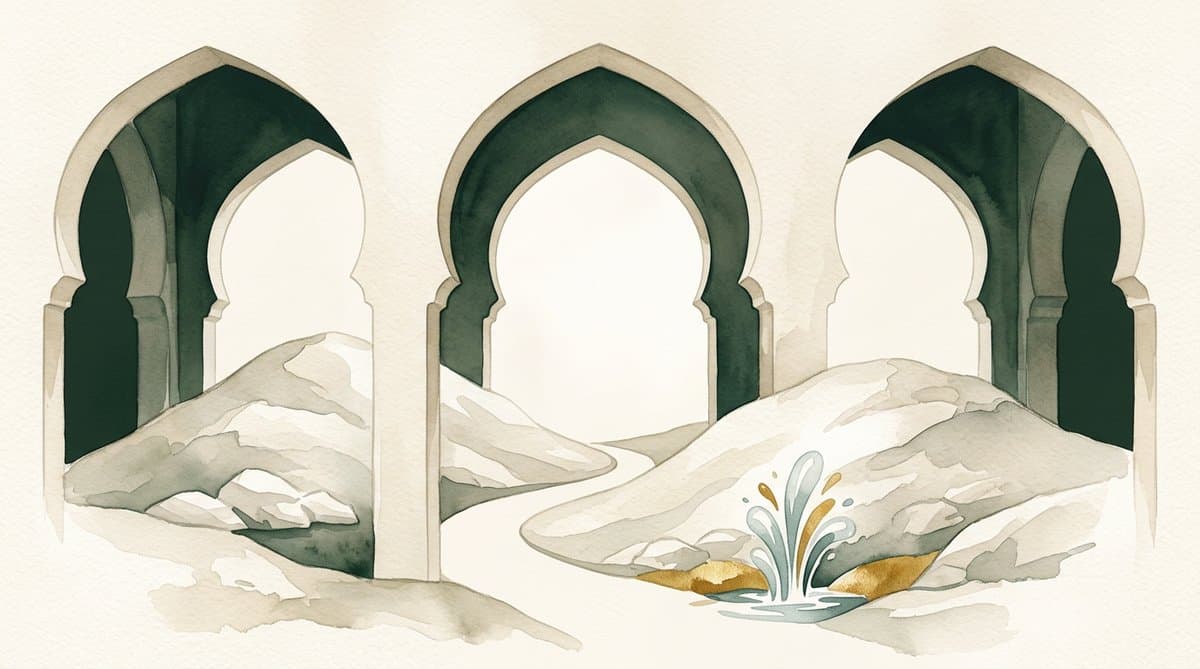
Sa’i, the ritual walking between the hills of Safa and Marwa, is an essential pillar (rukn) of both Umrah and Hajj. It is not merely a physical act but a profound spiritual journey that commemorates the unwavering faith and desperate search of Hajar (peace be upon her), the wife of Prophet Ibrahim (peace be upon him). This guide will walk you through how to perform Sa’i in Umrah, from its historical roots to practical steps, ensuring your act of worship is performed with understanding and devotion.
The Story of Hajar: Understanding the Heart of Sa’i
To truly appreciate Sa’i, one must understand the story from which it originates. Prophet Ibrahim (peace be upon him), following a command from Allah, brought his wife Hajar and their infant son, Isma’il (peace be upon him), to the barren valley of Makkah. He left them with a small supply of water and dates and departed, placing his complete trust in Allah’s plan. Soon, their provisions ran out, and the baby Isma’il began to cry from thirst. In a state of maternal desperation, Hajar ran back and forth between the two nearest hills, Safa and Marwa, climbing each one to scan the horizon for any sign of water or travelers. She completed this circuit seven times, her heart filled with a mixture of anxiety for her child and unshakeable trust in her Lord.
Her relentless effort and profound faith were answered miraculously. When she returned to her son, she saw water gushing from the ground where his feet had been kicking the sand. This was the spring of Zamzam, a blessed source of water that continues to flow to this day. Allah immortalized Hajar’s struggle, turning her desperate footsteps into a mandatory act of worship for millions of Muslims until the end of time. The Quran itself acknowledges the sanctity of these two hills: « Indeed, as-Safa and al-Marwah are among the symbols of Allah. » (Surah Al-Baqarah, verse 158).
Therefore, when a pilgrim performs Sa’i, they are not just walking; they are retracing the steps of a pious woman whose reliance on Allah (Tawakkul) was absolute. It is a powerful reminder that human effort is essential, but ultimate reliance must be on God. Sa’i teaches us perseverance in the face of hardship, hope when all seems lost, and the certainty that Allah always responds to the sincere supplications of His servants. It is a ritual that connects every pilgrim to a legacy of faith, sacrifice, and divine mercy.
Prerequisites and Preparation for a Meaningful Sa’i
Sa’i is performed after completing the Tawaf of Umrah and praying two rak’ahs behind Maqam Ibrahim (or wherever possible in the Haram). Before beginning, it is important to be properly prepared, both spiritually and physically, to ensure the ritual is performed correctly and comfortably. Spiritually, the most crucial element is the intention (Niyyah). Your intention to perform Sa’i for Umrah should be present in your heart; it does not need to be uttered aloud. It is a silent contract between you and Allah, affirming that you are undertaking this act solely for His pleasure.
Regarding physical purity (taharah), scholars agree that having wudu (ablution) is highly recommended (Sunnah) but not a strict condition (wajib) for Sa’i, unlike Tawaf. This is a point of ease from Allah, as the seven laps can be strenuous, and one might lose their wudu. However, beginning and maintaining wudu throughout the Sa’i is a sign of reverence for the ritual and is the practice of the Prophet Muhammad ﷺ. If your wudu breaks during Sa’i, you can complete the ritual without it, and it will be valid. After completing Tawaf, it is also recommended to drink Zamzam water, facing the Kaaba, and making dua before proceeding to the Mas’a (the area for Sa’i).
Practical preparation is equally important for a smooth experience. The distance of one lap between Safa and Marwa is approximately 450 meters, meaning the total distance for seven laps is about 3.15 kilometers. It is advisable to wear comfortable, broken-in footwear to avoid blisters. Pilgrims should ensure they are well-hydrated. Zamzam water coolers are conveniently placed throughout the Mas’a. The entire area is now enclosed and air-conditioned, making the ritual accessible at any time of day. To avoid the largest crowds, consider performing Sa’i late at night, after Fajr prayer, or during the mid-morning hours. For a journey as spiritually significant as Umrah, staying organized with your acts of worship is key. You can use tools that provide accurate prayer times in Makkah to schedule your Tawaf and Sa’i around the daily prayers, allowing you to join the congregation.
The Seven Laps of Sa’i: A Detailed Walkthrough
Performing the Sa’i involves seven laps, starting at Safa and ending at Marwa. Each journey from one hill to the other is considered one lap. The process is straightforward and filled with opportunities for personal reflection, dhikr, and dua. There are no prescribed supplications for each lap, which allows the pilgrim to communicate with Allah in their own words, pouring out the contents of their heart. However, there are specific Sunnah recitations at the beginning and when upon the hills themselves.
Upon arriving at the hill of Safa, you should turn to face the Kaaba, raise your hands in supplication, and recite the Takbir (« Allahu Akbar »), Tahlil (« La ilaha ill-Allah »), and praise Allah. It is Sunnah to recite what the Prophet ﷺ recited: « La ilaha ill-Allahu wahdahu la sharika lah, lahu’l-mulk wa lahu’l-hamd wa huwa ‘ala kulli shay’in qadir. La ilaha ill-Allahu wahdah, anjaza wa’dah, wa nasara ‘abdah, wa hazama al-ahzaba wahdah. » (There is no god but Allah alone, with no partner or associate; His is the dominion, to Him be praise, and He has power over all things. There is no god but Allah alone; He fulfilled His promise, granted victory to His servant, and defeated the confederates alone). You may then make any personal dua you wish. This should be done at the beginning of Sa’i at Safa and each time you arrive at Safa and Marwa during the subsequent laps.
After your initial supplications at Safa, you begin walking towards Marwa. This is your first lap. You should engage in remembrance of Allah, recite the Quran, or make personal duas. A significant part of the walk is a section marked by green lights on the ceiling. In this area, it is Sunnah for men to hasten their pace or jog lightly, while women should continue at a normal pace. This act emulates Hajar’s desperate running in the valley between the two hills. Once you reach Marwa, you have completed one lap. There, you should again face the Kaaba, raise your hands, and recite the same supplications and duas as you did at Safa. Then, you walk back to Safa for the second lap. You continue this process until you have completed seven full laps, with your final lap ending at the hill of Marwa. Throughout this sacred walk, you can find a wealth of supplications suitable for the occasion in the Al Muslim Plus app’s dua collection, which can serve as a helpful guide.
Summary of the Sa’i Laps
To simplify the process, here is a breakdown of the seven laps. Remember, the journey from one hill to the other counts as a single lap.
| Lap Number | Start | End | Key Actions |
|---|---|---|---|
| 1 | Safa | Marwa | Start with dua at Safa facing Kaaba. Walk towards Marwa. Men hasten between green lights. End with dua at Marwa. |
| 2 | Marwa | Safa | Walk back to Safa. Men hasten between green lights. End with dua at Safa. |
| 3 | Safa | Marwa | Walk towards Marwa. Men hasten between green lights. End with dua at Marwa. |
| 4 | Marwa | Safa | Walk back to Safa. Men hasten between green lights. End with dua at Safa. |
| 5 | Safa | Marwa | Walk towards Marwa. Men hasten between green lights. End with dua at Marwa. |
| 6 | Marwa | Safa | Walk back to Safa. Men hasten between green lights. End with dua at Safa. |
| 7 | Safa | Marwa | Walk towards Marwa. Men hasten between green lights. End with a final, longer dua at Marwa. Ritual is complete. |
Navigating Sa’i: Practical Advice and Common Mistakes to Avoid
While the steps of Sa’i are simple, the physical exertion and large crowds can present challenges. It is essential to approach the ritual with both spiritual focus and practical awareness. Remember that Sa’i is an act of worship, not a race. Maintain a dignified pace and be considerate of other pilgrims, especially the elderly, those with disabilities, and children. The Mas’a has multiple floors; the upper floors are often less crowded and can provide a more serene experience, though the walking distance may feel slightly longer. Wheelchairs are available for rent for pilgrims who are unable to walk the distance, and there are designated lanes to ensure their smooth passage.
Dua and Dhikr: What Should I Recite?
A common question is what to recite during the seven laps. There are no specific, obligatory duas for each lap. This is a mercy from Allah, allowing you to communicate with Him in a personal and heartfelt manner. You can recite any verses of the Quran you know, send blessings upon the Prophet Muhammad ﷺ (Salawat), ask for forgiveness (Istighfar), or simply praise Allah with phrases like « SubhanAllah, » « Alhamdulillah, » and « Allahu Akbar. » The most important aspect is that your heart and tongue are engaged in the remembrance of Allah. You can prepare a list of personal duas beforehand—for your family, your health, your livelihood, the Ummah, and for the hereafter. This is a special time when supplications are accepted.
Common Mistakes to Avoid During Sa’i
To ensure your Sa’i is valid and complete, it is helpful to be aware of some common mistakes pilgrims sometimes make. The first is starting the Sa’i from Marwa instead of Safa; the Quran mentions Safa first, and the Prophet ﷺ began there, so we must follow this order. Another error is counting a round trip (Safa to Marwa and back to Safa) as one lap, when it is actually two laps. This would result in performing only half the required ritual. Some pilgrims mistakenly believe they must complete Sa’i immediately after Tawaf without any break; while it is Sunnah to do so, it is permissible to rest, eat, or drink if needed. Finally, avoid getting distracted by conversations, shopping, or using your phone excessively. While taking a photo is not forbidden, the focus should remain on this profound act of worship. For more guidance on rituals, you can explore the many helpful resources and articles on Muslim life available to pilgrims.
After Completing Sa’i
Once you have completed the seventh lap, ending at Marwa, it is recommended to offer a final, lengthy dua. After this, the final step to exit the state of Ihram for Umrah is to cut or shave the hair. Men should preferably shave their entire head (halq), as the Prophet ﷺ prayed three times for those who shaved. Trimming the hair from all sides of the head (taqsir) is also permissible. Women should trim a small amount, roughly a fingertip’s length, from the ends of their hair. With this act, all the restrictions of Ihram are lifted, and your Umrah is complete.
Frequently Asked Questions
Is wudu (ablution) required for performing Sa’i?
While it is highly recommended (Sunnah) to have wudu for Sa’i, it is not a strict requirement (wajib) like it is for Tawaf. If your wudu breaks during Sa’i, you can continue the ritual, and it will remain valid.
How long does it take to complete Sa’i?
The total distance of Sa’i is approximately 3.15 kilometers (1.96 miles). For a person of average fitness, it typically takes between 45 to 90 minutes to complete, depending on their walking pace and the level of crowd congestion.
What is the significance of the green lights during Sa’i?
The green lights mark the portion of the Mas’a that was historically a valley (wadi). It is a Sunnah for men to hasten their pace or jog lightly between these lights, emulating Hajar’s desperate running as she searched for water. Women should continue walking at their normal pace.
What should I do after completing the seven laps of Sa’i?
After completing your seventh lap at Marwa, the final step to complete your Umrah is to cut or shave your hair. Men have the option to either shave their head completely (halq) or trim it (taqsir), with shaving being more virtuous. Women trim a small portion from the end of their hair.
Can I talk or drink water during Sa’i?
Yes, it is permissible to drink water during Sa’i, and Zamzam water coolers are readily available. It is also permissible to speak if necessary, but it is better to keep your tongue busy with the remembrance of Allah (dhikr) and supplication (dua) to maintain focus on the act of worship.
Do I have to perform Sa’i immediately after Tawaf?
It is Sunnah to perform Sa’i immediately after Tawaf and the two rak’ahs of prayer. However, if you are tired or need a break, it is permissible to rest before starting Sa’i. Your Sa’i will still be valid.
What if I lose count of the laps during Sa’i?
If you are in doubt about the number of laps you have completed, you should act on the basis of certainty. This means you should assume the lesser number you are sure of and then complete the remaining laps. For example, if you are unsure if you have done three or four laps, assume you have done three and proceed to complete the fourth.
Can women perform Sa’i during their menstruation?
Yes, a woman in a state of menstruation can perform Sa’i. While she cannot enter the prayer area of the mosque or perform Tawaf, the Mas’a (the area for Sa’i) is not considered part of the mosque in the same way, making it permissible for her to complete this ritual.
Sa’i is a beautiful and moving pillar of Umrah, transforming a simple walk into a profound act of faith and remembrance. By retracing the footsteps of Hajar, we are reminded of the power of perseverance and the infinite mercy of Allah. It teaches us to strive, to hope, and to place our ultimate trust in Him, knowing that every sincere effort made for His sake is seen and rewarded. May Allah accept your Umrah and your Sa’i.